Xerri's Grotto Gozo – A Hidden Cave Beneath a Family Home in Xagħra
Xerri's Grotto is one of Gozo's most unusual small attractions. From the street it looks like an ordinary family home in Xagħra, yet about 10 metres below the building lies a natural cave filled with stalactites, stalagmites and curious calcite formations created over thousands of years.
What makes the visit memorable is not only the cave itself. Xerri's Grotto is privately owned and traditionally shown to visitors by members of the Xerri family. There is no large museum entrance, visitor centre or polished tourist route. You enter a private residence, descend the spiral staircase built into the original well shaft and are personally shown around the family's grotto.
QUICK FACTS
Location: Triq l-Għar ta' Xerri, Xagħra, Gozo, Malta
Coordinates: approximately 36.05125, 14.26136
Type: privately managed natural limestone cave
Discovered: 1923/24 by Anthony Xerri while digging a well
Depth: approximately 10 metres below street level
Typical visit: around 20–30 minutes
Admission: allow approximately €3 per person and carry cash
Access: narrow spiral staircase; not suitable for wheelchairs and difficult for visitors with limited mobility
Current visitor listings commonly show 10:00–18:00. Because the grotto is inside a private family home and visits are personally guided, opening arrangements can change. If making a special journey, allow for the possibility that the family may temporarily be unavailable.
Why Xerri's Grotto is special
Many visitors come to Gozo for the coast, beaches and prehistoric temples. Xerri's Grotto offers something completely different: a small underground landscape hidden underneath a residential street.
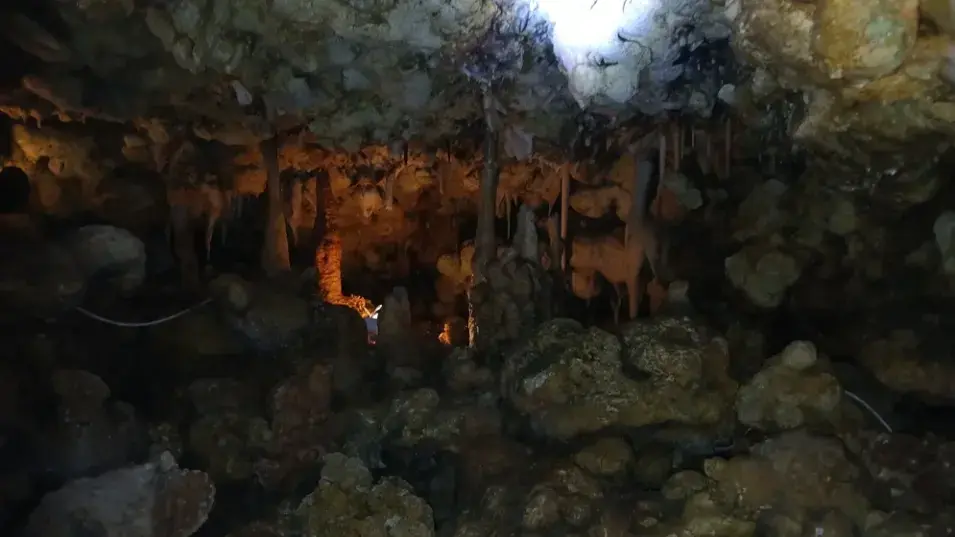
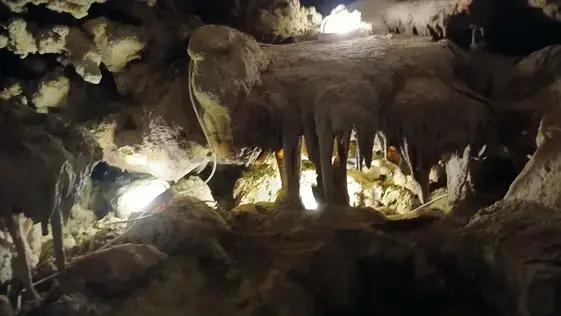
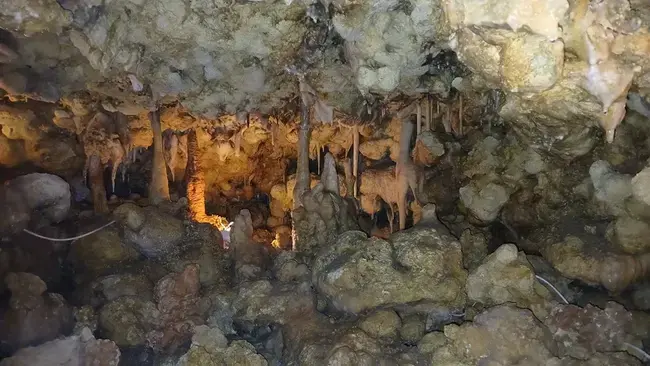
The cave contains numerous pale and honey-coloured dripstone formations. Stalactites hang from the ceiling while stalagmites grow upwards from the floor. In places they almost meet, creating columns and narrow curtains of calcite. Some formations are only a few dozen centimetres high, while others reach about a metre.
One of the pleasures of the family-guided visit is looking for familiar shapes. Various formations are traditionally compared with animals, including a tortoise, a vulture, giraffes and a pair of elephant's ears. Different visitors will see different silhouettes, which makes the experience surprisingly playful, especially for children.
How Xerri's Grotto was discovered
Xerri's Grotto was discovered in 1923 or 1924 by Anthony Xerri while he was digging a well beneath the family property. Instead of finding the expected water source, he broke through into a natural cavity.
After the discovery, Xerri abandoned the original plan for the well and began clearing debris from the cave. A path was created so that people could walk through part of the underground space. The spiral staircase used by visitors today occupies the shaft that was originally excavated for the well.
This gives the entrance an unusual character: rather than approaching through a natural cave mouth, you descend vertically from a house into a hidden chamber below the village.
How the stalactites and stalagmites formed
Xagħra is built on limestone, and rainwater slowly filters through cracks in the rock. As the water moves through the limestone it dissolves small amounts of calcium carbonate.
When a drop reaches the cave ceiling, some of that mineral is deposited. Over very long periods the deposits build downward to form stalactites. Water falling onto the floor can leave more calcite behind and gradually build a stalagmite upwards.
The process is extremely slow. The official Xagħra heritage information notes that even a few inches of growth can take thousands of years. That helps explain why the formations inside Xerri's Grotto should never be touched or damaged: what can be broken in seconds may have taken millennia to develop.
The cave also contains unusual formations associated with calcified tree roots. Water carrying calcium carbonate can coat roots and gradually leave mineral structures behind after the organic material changes or disappears.
The cave during the Second World War
Xerri's Grotto is also connected with Gozo's wartime history. During the Second World War the Xerri family used the underground space as an air-raid shelter.
That practical wartime use added another chapter to a cave already transformed by its accidental discovery. The underground chambers offered natural protection, while the access created from the house made the grotto immediately available to the family when air raids threatened the Maltese Islands.
Today the electric lighting and visitor path make the cave easy to understand, but the wartime story is a reminder that this was once much more than a curiosity for visitors.
What a visit is really like
The experience is refreshingly informal. At the time of my visit, members of the Xerri family were living directly above the grotto. You simply approach the entrance from the street. If the outside door is open, that is usually a good sign that somebody is at home. At the inner door there is a bell; ring it and a family member can come downstairs to let you in.
You are then taken into their grotto rather than being left to walk around alone. The personal explanation is an important part of the visit. The family points out the different formations, tells the story of how the cave was discovered and shows the animal-like shapes hidden among the stalactites and stalagmites.
The entrance was around €3 per person during my visit. Because this is a small privately managed attraction rather than a large ticketed museum, take some cash and regard the price and opening arrangements as practical guidance rather than a permanently fixed tariff.
This is exactly the kind of attraction I enjoy finding on Gozo: small, personal and easy to miss if you only visit the headline sights.
Opening hours and admission
Current local listings commonly show opening hours of 10:00–18:00 daily. Older published visitor information gives different hours, so the sensible approach is to treat the current times as indicative rather than guaranteed.
Admission is inexpensive. Recent visitors and my own visit indicate a price or requested contribution of about €3 per person. Carry cash, as this is a small family-run attraction.
You normally do not need an advance online ticket. The visit is arranged at the house itself and is personally guided when the family is available.
How long do you need?
Allow approximately 20–30 minutes for Xerri's Grotto. The cave is not enormous, but the family explanation and time spent examining the formations are part of the experience.
If you are exploring Xagħra on foot, it is easy to combine the grotto with Ninu's Cave, the village square, Ta' Kola Windmill and the Ġgantija Archaeological Park. A half-day in Xagħra can therefore include prehistoric archaeology, village life and two very different underground caves.
Accessibility and safety
The cave is about 10 metres underground and is reached by a narrow spiral staircase built into the original well shaft. Visitors must be comfortable with stairs, enclosed spaces and uneven underground surroundings.
Xerri's Grotto is not wheelchair accessible. It may also be unsuitable for anyone with significant mobility problems, poor balance or difficulty climbing narrow stairs.
Wear shoes with a secure sole. Move slowly, use the handrail where available and follow the family's guidance. Do not touch stalactites, stalagmites or other formations.
Getting to Xerri's Grotto
Xerri's Grotto is in the village of Xagħra on Gozo, on Triq l-Għar ta' Xerri. The entrance is easy to overlook because it forms part of a normal residential building.
Bus route 307 connects Victoria with Xagħra. Route 322 also serves Xagħra as part of its Gozo route. From the village centre, continue on foot through the residential streets to the grotto.
Driving is straightforward, but the surrounding streets are narrow and parking is mainly normal village street parking. Do not block house entrances, garages or narrow corners.
Xerri's Grotto or Ninu's Cave?
You do not really need to choose. The two caves are only about 100 metres apart and both are beneath private homes in Xagħra.
Xerri's Grotto is generally described as the larger and more varied of the two. Its circular visitor route and numerous formations make it especially interesting if you enjoy geology and unusual natural shapes. Ninu's Cave is another remarkable example of the hidden underground landscape below the village.
Visiting both gives a much better impression of how unexpected these natural cavities are beneath the streets of Xagħra.
What to see nearby
Ġgantija Archaeological Park
The UNESCO-listed Ġgantija temples are one of Gozo's essential historic attractions and are within easy walking distance of central Xagħra. The megalithic complex dates from the Neolithic period and is one of the oldest monumental stone structures in the world.
Ta' Kola Windmill
Ta' Kola Windmill stands close to Ġgantija. The historic windmill dates from the Knights' period and shows how grain was traditionally milled on Gozo. Heritage Malta operates the site together with Ġgantija under a combined ticket.
Xagħra village square
The central square is dominated by the Basilica of the Nativity of Our Lady and is a pleasant place to stop for a drink or meal. It also makes a useful reference point when walking between the caves and the archaeological sites.
Ramla Bay
Ramla Bay lies below Xagħra and is Gozo's best-known sandy beach, famous for its reddish-golden sand. It is a good contrast after an underground visit, particularly on a warm day.
Victoria and the Cittadella
Gozo's capital is only a short bus or car journey away. The Cittadella combines panoramic views with fortified streets, museums, historic buildings and the cathedral.
Exploring more of Gozo
Xerri's Grotto is best for independent visitors who have time to explore Xagħra slowly. If you are visiting Gozo for only one day, an organised island tour or hop-on hop-off bus can make it easier to combine Xagħra with Victoria, Dwejra, Ramla Bay and other major sights.
The Gozo hop-on hop-off sightseeing bus stops at Ġgantija Temples and Ta' Kola Windmill, placing you close to Xagħra's attractions. A full-day Gozo tour is another option if you prefer organised transfers and a broader island itinerary.
MaltaGuide.PRO may receive a commission when you book through these links. You pay no additional charge.
Local experience and source transparency
I visited Xerri's Grotto personally and photographed both the entrance and the cave interior. The practical description of ringing the bell, meeting the family and paying around €3 reflects that visit.
Historical and geological facts have been checked against the Xagħra Local Council, Visit Gozo's Xagħra Heritage Trail and current visitor information. Because Xerri's Grotto is privately managed inside a family home, opening times and admission arrangements can change more easily than at a state-run museum. Check locally if your itinerary depends on visiting at a particular time.
My recommendation is to combine Xerri's Grotto with Ġgantija and a walk through Xagħra. The grotto is not a large attraction, but its setting beneath an ordinary house and the personal family tour make it one of the most distinctive short visits on Gozo.