Ġgantija Temples Gozo: Tickets, History and Visitor Guide
The Ġgantija Temples in Xagħra are among the world’s oldest surviving free-standing stone monuments. Long before Stonehenge and the pyramids of Giza, Neolithic communities on Gozo were raising enormous limestone blocks and creating two linked ceremonial buildings on this hilltop plateau.
Today the site forms Ġgantija Archaeological Park, a UNESCO World Heritage property managed by Heritage Malta. A visit begins in the Interpretation Centre and continues along an outdoor route through the two temples. The admission ticket also includes nearby Ta’ Kola Windmill.
Ġgantija visitor information
Location: Triq John Otto Bayer, Xagħra, Gozo
Site: Ġgantija Archaeological Park
UNESCO status: Part of the Megalithic Temples of Malta World Heritage property; Ġgantija was inscribed in 1980
Date: Construction began around 3600 BC, with use and alterations continuing during later Neolithic phases
Admission: Adults aged 18 and over €10; young people aged 12–17, senior citizens aged 60 and over, students and other listed concessions €8; children aged 6–11 €6; children aged 1–5 free
Ticket includes: Ġgantija Archaeological Park and Ta’ Kola Windmill; Heritage Malta member and passport conditions apply
Recommended visit: About 1 hour for Ġgantija alone; allow additional time for Ta’ Kola Windmill
Public transport: Bus route 307 serves the Ggantija stop in Xagħra
Accessibility: The official site is fully accessible and has accessible toilets; disabled parking bays are available on a first-come, first-served basis
Photography: Personal photography is allowed without a tripod; flash is not allowed inside the Interpretation Centre
Why Ġgantija matters
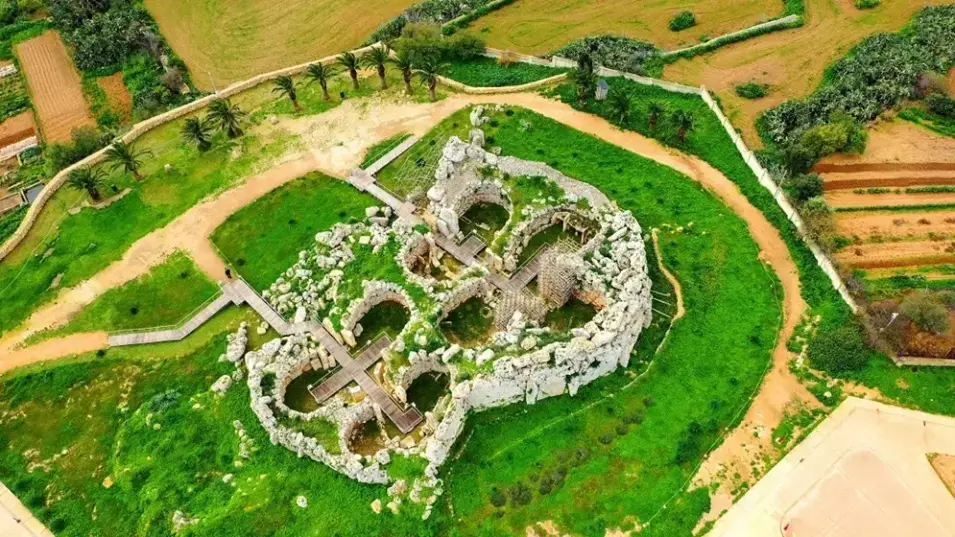
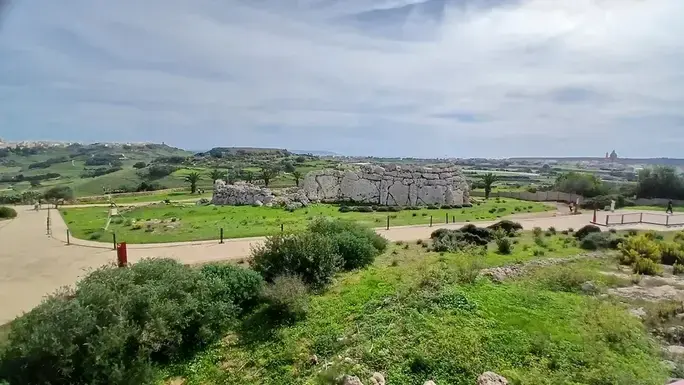
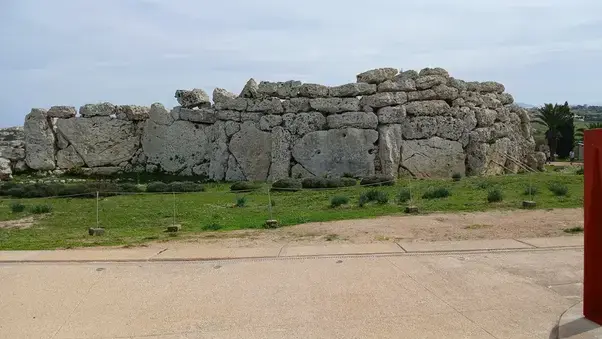
Ġgantija is not a single building. It consists of two temples with separate entrances enclosed by one immense outer wall. Inside each structure, curved apses open from a central passage. The larger South Temple was built first; the smaller North Temple was added later.
The scale is extraordinary, but the design is equally important. The builders selected hard Upper Coralline Limestone for much of the outer construction and softer Globigerina Limestone where a finer finish was useful, including doorways, altars and decorated slabs. This deliberate choice of stone reveals planning, specialist knowledge and a large communal effort.
Ġgantija opening hours in 2026
From January to February, Ġgantija is open on Monday and from Wednesday to Sunday from 09:00 to 17:00. It is closed on Tuesday, and last admission is at 16:30.
From March to October, it is open daily from 10:00 to 18:00, with last admission at 17:30.
From November to December, it is open daily from 09:00 to 17:00, with last admission at 16:30.
Heritage Malta sites are normally closed on 1 January, Good Friday, 24, 25 and 31 December. Hours can also change because of events, conservation work or exceptional circumstances. Check the official page shortly before travelling, especially around public holidays.
Tickets and what they include
The standard combined ticket costs €10 for adults aged 18 and over. The published rate is €8 for young people aged 12–17, senior citizens aged 60 and over, students and other listed concessions. Children aged 6–11 pay €6, while children aged 1–5 enter free. Bring valid proof when using an age-based or concession rate.
The ticket combines Ġgantija Archaeological Park with Ta’ Kola Windmill. Tickets bought through Heritage Malta’s online store are valid for 30 days from first use under the current conditions. Prices and terms can change, so verify them before payment.
What you see during the visit
The Interpretation Centre
The visit starts indoors with audiovisual material and objects that introduce Gozo’s Neolithic communities. Two small fragments of prehistoric plaster carrying red ochre are among the important finds displayed here. The centre gives context to the architecture outside without requiring visitors to understand archaeological terminology in advance.
The two-temple complex
After the museum, the route reaches the monumental remains. Both temples follow the characteristic Maltese plan: a central passage with rounded side chambers, or apses. Separate entrances lead into the South and North Temples, while the huge outer enclosure visually unites the complex.
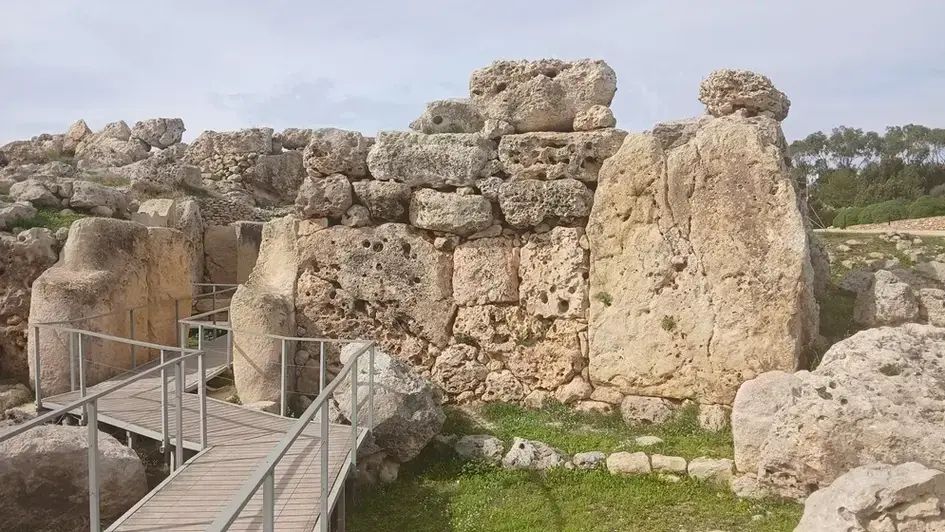
The entrance form was based on a trilithon: two upright stones carrying a horizontal lintel. Some original lintels no longer survive, but cuttings and notches still show how parts once fitted together. Perforations visible in certain megaliths may have been used with ropes, although their exact purpose remains uncertain.
The South Temple
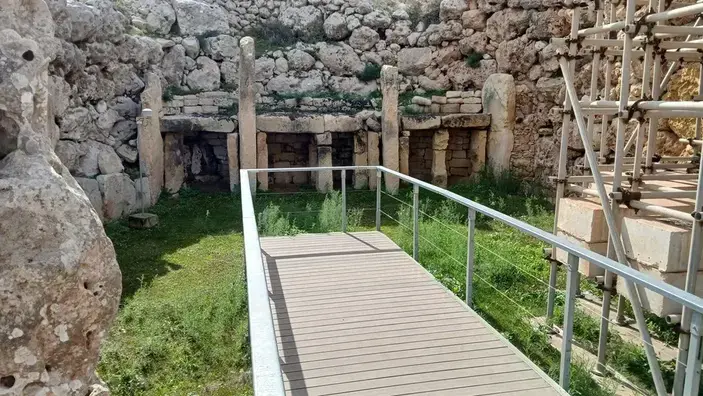
The South Temple is the earlier and larger structure. Its passage leads through a sequence of apses containing stone-built features conventionally described as altars, screens and hearths. Doorways and interior furnishings often use the softer Globigerina Limestone, which could be shaped more precisely than the hard stone used outside.
Round holes opposite one another near a doorway may once have held a barrier, door or bar. Such details are valuable because they show that the temple was an organised architectural space, not simply a rough enclosure.
The North Temple
The later North Temple is smaller but preserves the same broad arrangement of entrance passage and apses. Comparing the two structures helps visitors see how the architectural idea was repeated and adapted over time.
The open appearance today is not the original experience. Evidence from other Maltese temple sites, roofing studies and the inward lean of some walls suggests that at least parts of these buildings were covered. Archaeologists continue to debate the exact roof form and the way different spaces were used.
How old are the Ġgantija Temples?
Construction at Ġgantija began around 3600 BC. That makes its earliest monumental phases more than 5,500 years old and earlier than the main stone settings at Stonehenge and the pyramids of Giza.
Dates for prehistoric sites are ranges rather than a single birthday. Archaeologists use excavated layers, pottery sequences and radiocarbon evidence to reconstruct phases of construction, use, modification and abandonment. Heritage Malta therefore describes the broader archaeological remains at the park within a long Late Neolithic sequence rather than reducing the whole place to one year.
How were the temples built?
The largest stones weigh several tonnes. The builders had no iron tools, wheeled construction vehicles or modern lifting machinery. They quarried local limestone, shaped it with stone and bone tools, organised labour and moved blocks over the landscape.
Stone spheres found at Maltese temple sites may have helped move heavy blocks, perhaps as rollers or bearings, but no single transport method has been proved for every stage. Earthen ramps, timber, ropes and levers may also have played roles. The honest answer is that the engineering process is partly understood and still researched.
The stonework shows careful material selection. Hard Coralline Limestone could withstand exposure in the outer walls. Softer, honey-coloured Globigerina Limestone was easier to carve for inner surfaces, thresholds and architectural details.
What were the temples used for?
The buildings are called temples because their plan, deposits and furnishings point to communal ceremonial activity. Animal remains, pottery, stone features and traces of pigments all contribute to that interpretation. They were probably places for repeated gatherings and rituals rather than homes.
No Neolithic written records survive from Malta. We cannot identify the names of deities, the exact ceremonies or the status of the people who entered each space. Popular descriptions sometimes present Ġgantija as a fertility-goddess temple, but this is an interpretation, not a proven historical fact.
Why is it called Ġgantija?
The Maltese name derives from ġgant, meaning giant. A long-standing local legend said that only giants could have raised such enormous blocks. One version tells of a giantess who built the temples while carrying a child.
The story captures the impression the ruins made before scientific archaeology could explain their prehistoric origin. It belongs to Gozo’s cultural memory, but it is folklore rather than evidence about the builders.
Rediscovery and conservation
Ġgantija never disappeared completely from local knowledge. Early travellers and antiquarians recorded the ruins, and watercolours made in 1827 by Charles Frederick de Brocktorff are valuable evidence for parts of the site that later changed or collapsed.
Excavation, exposure and tourism brought new conservation challenges. Metal supports installed in the 1990s stabilised vulnerable sections, and Heritage Malta continues scientific monitoring and study. Some megaliths also carry historic graffiti, including marks dating from the early nineteenth century. These inscriptions are now part of the site’s history, but adding new marks would permanently damage the stone.
Book a guided Gozo tour with Ġgantija
Ġgantija is straightforward to visit independently. A guided day trip is useful when you are staying on Malta and want ferry transfers, transport and several Gozo highlights arranged in one booking. Always read the current itinerary, accessibility information and cancellation terms before paying.
Guided Gozo day trip with Ġgantija and lunch
This nine-hour tour from Malta currently combines the Ġgantija Temples with the Cittadella, Xlendi and Dwejra. The listing includes pickup, ferry travel, admission tickets, guiding and lunch. It is a broad island overview rather than an extended archaeological visit, and the provider states that it is not suitable for travellers with mobility impairments or wheelchair users.
Guided Gozo tour with temples and sightseeing train
This eight-hour option from Malta currently includes ferry travel, a licensed guide, admission to Ġgantija and a sightseeing-train ride. The activity listing marks the tour as wheelchair accessible, but individual transport and site requirements should still be confirmed directly for the chosen date.
Compare current Ġgantija tours
Use the activities page to compare live availability, prices, languages, reviews and pickup conditions. Confirm that the exact product includes admission to Ġgantija rather than only a panoramic stop in Xagħra.
AFFILIATE DISCLOSURE
MaltaGuide.PRO may receive a commission when you book through a GetYourGuide link. You pay no additional charge. MaltaGuide.PRO does not operate the tours; the activity provider remains responsible for the itinerary, transport, safety, accessibility and service.
How to get to Ġgantija
By bus
Malta Public Transport route 307 links Victoria with Xagħra and stops at Ggantija, stop number 1955. The stop is about a two-minute walk from the entrance. Services are currently roughly hourly, but timetables can change; check both your outward and return journey on the day.
By car or taxi
The park is around seven minutes by car from central Victoria and around sixteen minutes from Mġarr Harbour in normal conditions. Follow signs for Xagħra and Ġgantija Archaeological Park, allowing extra time when ferry traffic or village events are busy.
Free parking is available along the main road or in the designated car park near the separate temple exit. Accessible bays are limited and offered on a first-come, first-served basis. Do not block the entrance, exit, bus stops or residents’ access.
From Malta
Take the Gozo Channel ferry from Ċirkewwa to Mġarr, or a scheduled fast ferry from Valletta when operating. From Mġarr, continue by bus, taxi, rental car or an organised tour. Allow a buffer for ferry queues and connections, particularly on summer weekends.
Accessibility
Heritage Malta describes Ġgantija Archaeological Park as fully accessible. The Interpretation Centre has a lift, accessible toilets are available, and the visitor route uses ramps and boardwalks where needed. The outdoor setting still involves changing light, weather exposure and sections of historic stone visible beside the route.
Disabled parking bays are available but cannot be reserved. If a particular mobility aid, transfer arrangement or assistance is essential, contact the site before travelling on +356 2155 3194 and confirm the current route.
Facilities and visitor rules
The park has toilets, accessible toilets and a museum shop. There is no restaurant or café inside the attraction; Xagħra Square is approximately a five-minute walk from the entrance and has places to eat and drink.
Personal photography is allowed without a tripod. Do not use flash in the Interpretation Centre. Commercial photography, filming or drones may require advance permission.
Only assistance dogs are allowed. Do not touch, climb or sit on the archaeological stonework. Follow barriers and staff directions, and keep children close throughout the outdoor route.
Best time to visit
Spring and autumn usually offer comfortable temperatures and softer light for the open-air section. In summer, arrive near opening time or later in the afternoon, carry water and use sun protection. Shade inside the temples is limited.
Winter can be quiet and atmospheric, but wind and rain affect the exposed plateau. The site is closed on Tuesdays in January and February. Whatever the season, check current opening notices before leaving.
What to bring
Wear comfortable shoes with grip, even though the formal visitor route is accessible. Bring water, a hat and sunscreen from late spring to autumn. In winter, add a windproof or waterproof layer.
Keep your ticket if you plan to visit Ta’ Kola Windmill. A charged phone is useful for travel updates, but lower your voice and avoid blocking narrow parts of the route while taking photographs.
What to see nearby
Ta’ Kola Windmill
Ta’ Kola Windmill is a short walk away and is included in the standard Ġgantija ticket. Its reconstructed working spaces and domestic rooms show a much later layer of Gozitan history.
Xagħra and Ramla Bay
Xagħra Square is useful for lunch or coffee. Ramla Bay lies below the village and combines naturally with Ġgantija when you have a car, taxi or suitable bus connection.
Victoria and the Cittadella
Gozo’s compact capital is the main transport hub and makes an excellent second stop. The Cittadella combines fortifications, museums and wide island views.
Marsalforn Bay
Marsalforn offers a waterfront promenade, restaurants and swimming. It is a practical contrast to Ġgantija’s archaeological focus.
More prehistoric Malta
Ġgantija is one part of a wider prehistoric landscape that includes the other UNESCO-listed Megalithic Temples of Malta.
A Malta resident’s personal perspective
I personally believe that the Maltese temples may eventually prove to be older than the dates currently established. Discoveries such as Göbekli Tepe in present-day Türkiye, where monumental structures were built by hunter-gatherers between 9600 and 8200 BC, show that organised monumental construction began far earlier than scholars once thought. Göbekli Tepe does not itself prove an earlier date for Ġgantija, so this remains my personal view rather than the accepted archaeological dating.
Whatever your interpretation, my recommendation as a Malta resident is unequivocal: do not leave Malta without seeing at least one of its prehistoric temple sites. Ġgantija is one of the most impressive places to begin.
How this guide was checked
This guide combines first-hand photographs made at Ġgantija in October 2025 with on-site interpretation and current official visitor information. Opening hours, ticket prices, accessibility, photography rules and facilities were checked against Heritage Malta on 26 August 2026. UNESCO was used for World Heritage status, and Malta Public Transport for route 307.
The architecture and history are described cautiously where evidence is incomplete. Legends are identified as folklore, possible construction methods are presented as hypotheses, and no specific ritual or deity is stated as fact without supporting evidence.
For most independent visitors, the official combined ticket gives the best value and allows a flexible visit. Choose a guided day trip when transport from Malta and a wider Gozo itinerary are more important than spending extra time inside the temples.