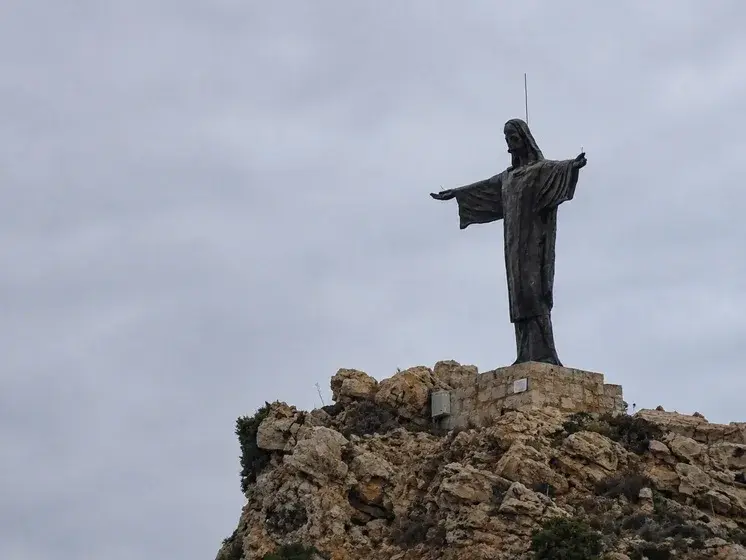
Tas-Salvatur Hill Gozo – Christ Statue, History and Walk
Rising above the countryside between Marsalforn and Victoria, the Risen Christ of Tas-Salvatur Hill is one of Gozo’s most recognisable landmarks. The six-metre figure stands with outstretched arms on the summit of Tal-Merżuq, a steep, cone-shaped hill approximately 97 metres above sea level.
The statue can be seen from large parts of Gozo, but the experience changes completely when you walk to the summit. Up close, the monument reveals its scale, exposed setting and weathered surface. Turn around and the reward is a broad panorama across Marsalforn, Gozo’s fields and villages, the north coast and the Citadel on the southern horizon.
Tas-Salvatur is not a conventional visitor attraction. There is no ticket office, café, visitor centre or paved sightseeing platform. The climb is short, free and memorable, but the path is steep, rough and exposed. This guide explains the history, legends, walking route, transport, safety advice and the best Gozo tours to combine with your visit.
Tas-Salvatur Hill Quick Facts
Official Visit Gozo name: Tas-Salvatur Hill
Other names: Tal-Merżuq, Is-Salvatur and L-Għolja tas-Salvatur
Location: South of Marsalforn, Gozo, Malta
Official map coordinates: 36.066602, 14.254417
Hill height: Approximately 320 feet, or 97 metres, above sea level
Current statue: Risen Christ with outstretched arms
Statue dimensions: Approximately 6 metres high with a 6-metre arm span
Current statue installed: July 1979
Artist: Gozitan sculptor and teacher Carmel Grech, working with students from Gozo Technical School
Admission: Free; there is no staffed entrance or admission ticket
Formal opening hours: None published for this open-air hilltop; visit in daylight
Typical walk from Marsalforn: Approximately 2.4 kilometres return
Walking time: Allow about 50–75 minutes for the return walk, plus time at the summit
Difficulty: Short but steep, uneven and exposed; supportive footwear is essential
Accessibility: Not suitable for wheelchairs, pushchairs or visitors who cannot manage steep, rough ground
Facilities on the hill: None; use shops, cafés and toilets in Marsalforn before starting
Best time: A dry morning or late afternoon; avoid intense midday heat, strong wind and thunderstorms
Why Visit the Risen Christ on Tas-Salvatur Hill?
Tas-Salvatur combines four experiences in one compact visit: a short country walk, an unusual work of modern religious sculpture, wide views and a story shaped by faith, weather and Gozitan folklore.
The hill is particularly rewarding for travellers who enjoy places that feel separate from Gozo’s better-known sightseeing circuit. You may see the statue from a bus or car, but the climb reveals why generations of islanders treated this summit as a beacon, a place of protection and a visible statement of faith.
The walk also works well before breakfast, before a swim in Marsalforn or late in the afternoon when the light softens. Allow enough daylight for the descent and never rely on the hilltop lighting to illuminate the path.
The History of Tas-Salvatur Hill and Its Statues
An Earlier Tradition from 1870
Visit Gozo records an oral tradition that reaches back to 1870. During a dry summer, a local farmer is said to have promised to place a statue of Our Saviour on the hill if rain arrived. A later thunderstorm reminded him of his pledge.
This account belongs to local tradition rather than a securely documented construction record. It nevertheless shows that the hill’s connection with gratitude, rain and divine protection predates the first well-documented monument.
The Wooden Cross of 1901
In 1901, farmers erected a large wooden cross on the summit. Visible from the sea, it became a sign of hope and protection for fishermen leaving and returning to Marsalforn Bay.
The position was deliberately powerful. The conical hill rises above open farmland and forms a natural marker when approaching the north coast of Gozo.
The First Major Statue in 1904
Three years later, Gozo was consecrated to Jesus the Redeemer. The wooden cross was replaced by a statue carved from local Globigerina limestone by Liberat Borg of Birgu.
This first major statue showed Christ carrying a large wooden cross. The dedication strengthened the name Tas-Salvatur, meaning the hill of the Saviour or Redeemer.
The exposed summit proved unforgiving. Salt-laden winds, rain and temperature changes gradually damaged the limestone, and the monument deteriorated.
Wistin Camilleri’s 1960 Statue
In November 1960, a new concrete statue was installed from designs by the respected Gozitan sculptor Wistin Camilleri. It was approximately seven and a half metres high and again represented Christ with his cross.
The second modern monument survived for only thirteen years. During a violent storm on 7 January 1973, lightning struck the structure and it collapsed. Fragments associated with this earlier statue have remained around the summit.
The Present Risen Christ, Installed in 1979
The current monument was created by Gozitan sculptor and Gozo Technical School teacher Carmel Grech with the participation of his students. Unlike the earlier cross-bearing figures, this six-metre statue presents the Risen Christ with both arms extended across a six-metre span.
The difficult terrain ruled out a normal crane installation. The outer shell was divided into six sections, transported uphill and assembled on the pedestal. Concrete was then poured into the shell on site, creating a solid structure able to withstand the exposed conditions.
The statue reached the summit in July 1979. Visit Gozo records that Grech modelled the figure on his young nephew Mario. That nephew later became Bishop of Gozo and is now Cardinal Mario Grech.
Restoration and Lighting
Exposure continued to affect the present statue. Restoration work managed by the Ministry for Gozo and Wirt Għawdex repaired damage near the head, protected the surface and added specialist solar lighting. A major restoration of the fibreglass exterior took place in 2014.
The monument is illuminated at night, but this should not be confused with a lit walking route. The approach remains rough country terrain and is safest in good daylight.
Tal-Merżuq, the Ray of Light
Before Tas-Salvatur became the dominant name, the hill was known as Tal-Merżuq. Merżuq is associated with a ray or beam of light, and several stories explain the name.
One legend tells of three days of darkness over Gozo, followed by a ray of light appearing from the hill. Another tradition describes fishermen lost in mist who saw the summit illuminated by a break in the clouds and used it to guide their boat safely back towards Marsalforn.
The hill was also called Il-Munġbell, or “the small Mongibello”, because its pyramid-like outline reminded Gozitans of Mount Etna in Sicily. Stories of black smoke encouraged a belief that the hill might be a dormant volcano. Visit Gozo notes that geologists dismiss this idea: the volcanic appearance belongs to the hill’s shape and folklore, not to active volcanism.
These accounts should be read as part of Gozo’s living oral heritage. They explain how the landscape was understood by earlier communities without turning local legend into geological fact.
Walking to the Top from Marsalforn
The most practical starting point is Marsalforn Bay. A commonly used return route is approximately 2.4 kilometres and takes about 50–75 minutes, excluding time at the summit. The height gain is modest, but most of it is concentrated on a short, steep rural path.
The route is not a surfaced promenade or a consistently signposted official trail. Access conditions around agricultural land can change. Follow only an established public path, respect all gates and signs, stay out of cultivated fields and never climb over a barrier or enter land marked as private. If the approach appears closed or unclear, turn back and ask locally for the current public access route.
Step-by-Step Walking Outline
1. Start near the Marsalforn bus terminus and waterfront, where you can buy water and use available facilities.
2. Walk south from the bay towards the main Marsalforn–Victoria road, remaining on the pavement where one is available.
3. Use the official Visit Gozo map pin for the summit and identify the established rural approach from the Marsalforn side.
4. Continue only on the visible public track. Do not shortcut across fields or disturb rubble walls, crops, livestock, gates or irrigation equipment.
5. Expect the final section to become steeper, rockier and less even. Slow down and use your hands for balance only when necessary.
6. Return by the same legal route unless you are certain that an alternative path is public and open.
How Difficult Is the Walk?
The distance is short, but the official Visit Gozo history warns that parts of the climb are steep and uneven. Loose stones, bare rock, ruts and dry soil can reduce grip. After rain, mud and limestone may become slippery.
This is best described as a short hill walk rather than an easy urban stroll. Most active visitors with suitable footwear and reasonable balance can manage it slowly in dry conditions. It is not a suitable route for wheelchairs, mobility scooters or pushchairs.
What You Can See from the Summit
The exposed summit provides a near-360-degree view. To the north lies Marsalforn and the Mediterranean. Across the interior are Gozo’s terraced fields, limestone villages and church domes. Victoria and the Citadel appear on the southern horizon.
On exceptionally clear days, the distant outline of Sicily may be visible. Mount Etna’s historical association with the hill helps explain the old name Il-Munġbell, although visibility should never be promised because haze and weather change quickly.
Safety, Weather and What to Bring
Tas-Salvatur has little or no shade. The exposed summit can also be windy when conditions in Marsalforn feel calm.
Bring:
• supportive walking shoes with good grip;
• at least one bottle of water per person, and more in warm weather;
• a hat and high-factor sun protection;
• a charged phone with the map saved;
• a light windproof layer outside summer;
• any essential medication.
Avoid the climb:
• during the fiercest midday heat;
• in thunderstorms or when lightning is forecast;
• during strong winds;
• immediately after heavy rain;
• in darkness or when there is insufficient daylight for the descent.
There are no guaranteed toilets, drinking-water points, railings, first-aid facilities or staff on the hill. Tell someone where you are going if walking alone, keep children close and carry all rubbish back to Marsalforn.
Accessibility and Visiting with Children
The summit path is not wheelchair accessible. It is also unsuitable for mobility scooters and ordinary pushchairs because of the gradient, loose stones and uneven final approach.
Families with older children may enjoy the walk in cool, dry weather, provided each child is confident on rough ground and remains closely supervised. The summit has steep natural slopes, sharp rocks and no protective railings.
Do not carry a child in a way that affects your balance. Visitors with reduced mobility can still view the landmark from the Marsalforn–Victoria road and from several points around central Gozo.
Opening Hours, Admission and Facilities
Tas-Salvatur Hill is an open-air landscape rather than a managed attraction. No formal visitor opening hours or admission charge are published, and there is no ticket office at the approach.
Visit in daylight and allow a safety margin before sunset. The statue may be illuminated after dark, but the path itself should not be treated as lit or supervised.
There are no visitor facilities on the summit. Marsalforn is the best place to find cafés, restaurants, shops, transport and toilets before or after the walk.
How to Reach Tas-Salvatur Hill
By Bus from Victoria
Malta Public Transport route 310 links Victoria with Marsalforn. Leave the bus in Marsalforn and begin the walk from the bay area. Timetables and temporary diversions can change, so check the official route shortly before travelling.
By Bus from Mġarr Ferry Terminal
Route 322 connects Mġarr, several eastern Gozo localities and Marsalforn. Depending on the timetable, travelling via Victoria and changing to route 310 may be an alternative. Use the official journey planner for the day and time of travel.
By Car or Taxi
Drive or take a taxi to Marsalforn and complete the final section on foot. Do not attempt to drive onto the rural hill path. Parking near the waterfront is limited during summer and busy evenings, so arrive early or park farther from the bay without obstructing residents, fields, gates or emergency access.
From Malta to Gozo
Gozo Channel operates the vehicle and passenger ferry between Ċirkewwa and Mġarr. Fast passenger services also operate between Valletta and Gozo. Sea conditions and operational changes can affect services, so check the operator’s current timetable rather than relying on an old schedule.
Does Tas-Salvatur Hill Require a Ticket?
No admission ticket is required for the hill or statue. Paid bookings become relevant when you want transport, a guide or a wider Gozo experience around the same day.
Tas-Salvatur itself is not confirmed as a scheduled stop on the tours below. Never book a general Gozo tour on the assumption that it will climb this hill. Instead, use an organised activity to explore more of the island and plan the Tas-Salvatur walk separately when time, access and weather allow.
Best Gozo Tours to Combine with Tas-Salvatur
Full-Day Gozo Jeep Tour
This chauffeured excursion is suited to first-time visitors who want to see many parts of Gozo without organising buses and parking. The current itinerary includes major sights and passes through Marsalforn Bay on its way towards Mġarr. It does not list a climb to Tas-Salvatur Hill.
The activity currently includes transport from selected Malta pickup points, an experienced driver, lunch and the required sea crossing. Exact stops, boat arrangements and seasonal swim opportunities remain subject to the booking date, weather and operational conditions.
Guided Gozo E-Bike Tour
The current 3.5-hour small-group e-bike experience visits the Xwejni Salt Pans near Marsalforn, Ta’ Pinu Basilica and Wied il-Mielaħ. It offers an active way to see Gozo’s north-western countryside with a guide and includes e-bike rental.
Tas-Salvatur is not listed as a standard stop. Ask the activity provider before booking if you have a route request, but do not assume that the hill can be added.
Guided Dwejra Hiking Tour
If you want a longer walk with a local guide, the current small-group Dwejra hiking tour explores Gozo’s west coast, including rugged paths, cliffs, the Inland Sea and the Blue Hole area. It is a separate experience and does not visit Tas-Salvatur, but it is a relevant choice for travellers who prefer guided hiking.
Compare More Marsalforn and Gozo Activities
Activity availability and prices change with the season. The Marsalforn activity overview is useful when you want to compare sightseeing, Jeep, quad, buggy, boat and water-based options for your exact date.
Why Book Through GetYourGuide?
GetYourGuide allows visitors to compare current dates, languages, pickup arrangements, inclusions, cancellation terms and verified reviews before choosing an activity. This is particularly useful on Gozo because ferry arrangements, seasonal boat transfers and tour routes can differ between products.
Always read the current activity page before paying. Confirm whether your accommodation is inside the pickup area, whether attraction admission is included and whether the activity is suitable for your mobility, age and fitness.
What to See Nearby
Marsalforn Bay
Marsalforn is the natural base for the walk. Combine the climb with breakfast, a swim in calm conditions, the waterfront promenade or lunch beside the bay.
Xwejni Salt Pans
West of Marsalforn, the coast around Qbajjar and Xwejni contains a striking landscape of salt pans cut into the limestone. Remain on the road or designated route and never walk inside working pans.
Victoria and the Citadel
The Citadel is visible from Tas-Salvatur and provides a second elevated perspective across Gozo. Victoria is also the island’s main public-transport hub and works naturally before or after Marsalforn.
Ta’ Pinu Basilica
Ta’ Pinu is one of Gozo’s most important religious landmarks. Its monumental limestone architecture, historic chapel and open countryside setting provide a different expression of Gozitan faith from the solitary statue on Tas-Salvatur.
Dwejra Bay
Dwejra lies on Gozo’s west coast and combines dramatic limestone scenery with the Inland Sea, Blue Hole, Fungus Rock and coastal walking opportunities. It is best reached by bus, car, taxi or organised tour rather than added to the same walk.
Responsible Visiting
Tas-Salvatur stands within a working rural landscape. Protect it by staying on the established legal path, closing any gate that you are permitted to use, avoiding crops and livestock, and taking every item of rubbish away with you.
Do not climb on the statue, pedestal or fragments around the summit. Do not scratch names into stone, light fires or leave religious objects without permission. Drone use in Malta is regulated; confirm aviation, safety and privacy requirements before flying near people, roads, homes or the monument.
Information Sources and Local Reliability
This guide was checked on 24 August 2026 against the official Visit Gozo location page and historical feature, Malta Public Transport routes 310 and 322, current Gozo ferry information and the live GetYourGuide activity descriptions linked above.
Folklore is identified as tradition rather than presented as geology or proven history. Tour descriptions state clearly when Tas-Salvatur is not a confirmed stop. Because the rural approach can change, visitors are instructed to respect current signs, gates and property boundaries instead of relying blindly on an old route description.
Is Tas-Salvatur Hill Worth Visiting?
Yes, if you can safely manage a short but steep walk. The statue is unusual, the layered history is genuinely Gozitan and the summit provides one of the most rewarding free viewpoints near Marsalforn.
The experience is strongest when treated as a small adventure rather than a formal attraction. Start early or late, wear proper shoes, carry water and give yourself time to absorb the views. Afterwards, return to Marsalforn for the sea, restaurants and onward transport — or continue your Gozo day with a pre-booked tour that matches your interests.