



Go to content

Ta’ Pinu Basilica Gozo – Mass Times, History and Visitor Guide


Ta’ Pinu Basilica is Malta’s National Shrine and one of the most important religious landmarks in Gozo. Standing in open countryside near Għarb, the sanctuary is known for its Romanesque architecture, the historic chapel associated with Karmni Grima, its ex-voto collection and its long tradition of pilgrimage.

This visitor guide explains the history of Ta’ Pinu, current Mass times, museum opening hours, accessibility, parking, public transport and the most important things to see during your visit.

Introduction

Standing proudly in the peaceful countryside near the village of Għarb, Ta' Pinu Basilica is one of the most remarkable landmarks in Malta. Its impressive limestone architecture, fascinating history and spiritual importance attract hundreds of thousands of visitors every year.

As a resident of Malta, I travel to Gozo regularly, certainly twice a year, and always visit the church. The impressive images created using small pieces of tile continue to impress me; this church is well worth a visit.

For many people, Ta' Pinu is much more than a church. It is Malta's National Shrine, an internationally recognised pilgrimage destination and one of the island's greatest architectural masterpieces.

Visitors come to admire the magnificent building, attend Mass, discover its history, enjoy the surrounding countryside or simply experience the unique atmosphere that makes this place so special.

Even if you are not religious, Ta' Pinu deserves a place on every Gozo itinerary. The basilica combines history, culture, architecture, art and beautiful landscapes in one unforgettable destination.

Many organised Gozo day tours include a stop at Ta' Pinu, making it easy to combine your visit with other famous attractions such as the Citadel, Dwejra Bay, Xlendi, Marsalforn and the Gozo Salt Pans.

The History of Ta' Pinu Basilica

Few buildings in Malta have a history as remarkable as Ta' Pinu Basilica. Although the impressive church that visitors see today dates from the twentieth century, the origins of this sacred place go back more than five hundred years.

Historical records show that a small country chapel already stood here during the fifteenth century. Surrounded only by farmland and rolling hills, it served local farmers and travellers who stopped to pray while crossing western Gozo.

During an inspection in 1575, the Apostolic Visitor Monsignor Pietro Dusina ordered that many neglected rural chapels should be demolished, including the small chapel at Ta' Pinu. According to local tradition, the first workman who attempted to strike the building immediately broke his arm. The incident was interpreted as a divine sign and the demolition order was abandoned. The chapel therefore survived while many others disappeared forever.

The chapel became known as Ta' Pinu, named after Pinu Gauci, a local benefactor who cared for the building during the seventeenth century.
Inside the chapel hung a painting of the Assumption of the Blessed Virgin Mary. This painting, created by Bartolomeo Amodeo Perugino in 1619, remains one of the most treasured objects inside the basilica today.

Everything changed on 22 June 1883.
A local woman named Karmni Grima was walking past the chapel when she reportedly heard a female voice calling her twice:
"Come... Come..."
After entering the chapel she was asked to recite three Hail Marys in remembrance of the three days Christ spent in the tomb.
At first she kept the experience private, but later another local resident, Francesco Portelli, reported a similar spiritual experience. Soon afterwards numerous people claimed to have received healing or other favours after praying to Our Lady of Ta' Pinu.
News spread rapidly across Malta and beyond.

Pilgrims began arriving in ever increasing numbers, transforming the isolated country chapel into one of the most important Marian shrines in the Mediterranean.
Eventually the original chapel became far too small.

Instead of replacing it, church authorities made the remarkable decision to preserve it completely and construct a magnificent basilica around it.
Construction of the present church started on 30 May 1920.

The basilica was officially opened in 1931 and consecrated in 1932.
Later that same year Pope Pius XI granted Ta' Pinu the title of Minor Basilica, recognising its exceptional spiritual importance.

Today it officially bears the name:
Basilica of the National Shrine of the Blessed Virgin of Ta' Pinu.

Several Popes have honoured Ta' Pinu.
Pope Saint John Paul II celebrated Mass here during his visit to Malta in 1990.
In 2010 Pope Benedict XVI awarded the shrine the Golden Rose, one of the highest honours a Pope can bestow upon a Marian shrine.
Pope Francis visited Ta' Pinu in 2022 during his Apostolic Journey to Malta.
Today Ta' Pinu welcomes pilgrims, architects, historians, photographers and tourists from every continent.

Architecture and Construction

One of the reasons Ta' Pinu attracts so many visitors is its extraordinary architecture.
The basilica was designed by the celebrated Maltese architect Andrea Vassallo (1856–1928), widely regarded as one of Malta's greatest church architects. Following his death, the project was completed under the supervision of architect Godwin Galizia, while remaining faithful to Vassallo's original vision.

The building is designed in the Neo-Romanesque style, inspired by the great medieval churches of Europe.
Unlike many churches that are surrounded by buildings, Ta' Pinu rises alone from the open Gozitan countryside. This isolated position was intentional and gives the basilica its dramatic appearance. From several kilometres away the bell tower dominates the landscape and immediately draws the eye.

The church measures approximately 49 metres in length and 37 metres in width, while its elegant bell tower rises to about 61 metres above the surrounding fields.

Every stone of the basilica was cut from the famous golden limestone of Gozo. This natural stone gives the building its warm colour, which changes beautifully throughout the day as the sunlight moves across the façade.

The architects also made the unusual decision to preserve the original fifteenth-century chapel intact.
Rather than demolishing it, the chapel became part of the new basilica and can still be visited today. This unique combination of old and new architecture is one of the most remarkable features of Ta' Pinu.

Inside, visitors discover magnificent arches, richly decorated ceilings, colourful stained-glass windows, marble floors, mosaics and beautifully carved stone columns.
Every architectural detail was designed to direct attention towards the original miraculous chapel and the historic painting of Our Lady.

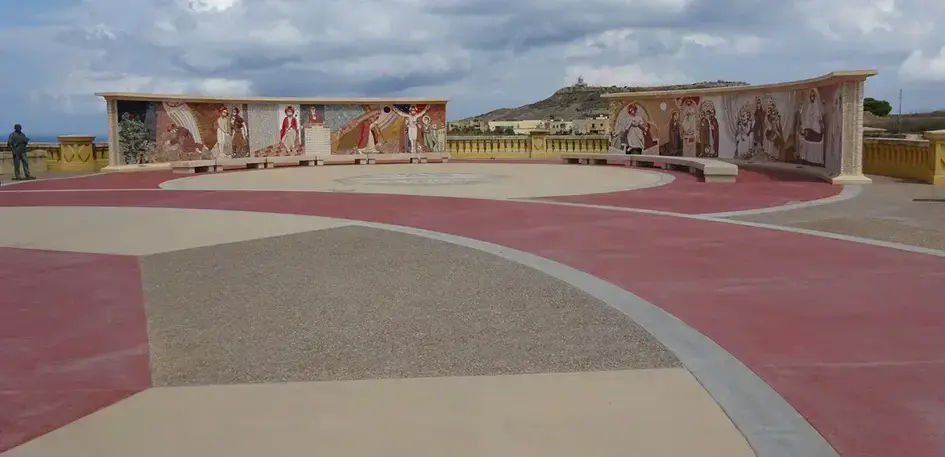
Ta Pinu features several impressive outdoor artworks that reflect biblical stories.

Interesting Architectural Facts

Architecture enthusiasts will notice many remarkable details throughout the basilica.
The building contains virtually no reinforced concrete in its visible structure. Instead, it follows traditional European church-building techniques using massive limestone masonry.

Because the church stands alone in open countryside, it acts as a visual landmark from many parts of western Gozo.

The impressive bell tower remains one of the tallest structures on the island and serves as a navigational point for both visitors and local residents.
The Neo-Romanesque style is characterised by large rounded arches, thick supporting walls, symmetrical façades and an atmosphere of strength and permanence. Andrea Vassallo deliberately selected this architectural style to reflect the timeless character of the sanctuary.

Perhaps the greatest architectural achievement is the seamless integration of the original chapel within the modern basilica. Rather than becoming a museum piece, the old chapel remains an active place of prayer and forms the spiritual heart of the entire complex.

Why Visit Ta' Pinu Basilica?

Whether you are interested in history, architecture, religion or photography, Ta' Pinu offers something unique.
Visitors come here to admire one of Malta's most beautiful churches, experience the peaceful atmosphere, discover fascinating stories of faith, admire centuries of religious art and enjoy panoramic views across the Gozitan countryside.

Unlike many busy tourist attractions, Ta' Pinu still feels authentic.

It remains a living place of worship where local residents attend Mass alongside visitors from around the world.
The combination of impressive architecture, historical importance and rural tranquillity makes Ta' Pinu one of the highlights of every visit to Gozo.

Visitor Guide

Most visitors spend between 45 minutes and 90 minutes exploring Ta' Pinu.

If you also wish to visit the museums, walk the Stations of the Cross on nearby Ta' Għammar Hill and spend time enjoying the peaceful surroundings, allow approximately two hours.

Morning visits usually provide the best light for photography and are generally quieter than weekends and religious feast days.

Please remember that this is an active church. Visitors are asked to dress respectfully, speak quietly and avoid disturbing people attending Mass or private prayer.

The Ta' Pinu Museums

Although the basilica itself is the main attraction, visitors can also explore several small museum collections that provide a deeper understanding of the shrine's history.

The Sanctuary Museum displays religious art, historic objects, papal gifts and information about the development of Ta' Pinu over the centuries.

The Ex Voto Museum contains hundreds of personal offerings donated by pilgrims who wished to express gratitude for prayers they believed had been answered. These include paintings, photographs, written testimonies and other deeply personal objects.

A third museum, the Karmni Grima Museum, is located in the nearby village of Għarb. Situated in the restored home of Karmni Grima, it tells the story of the woman whose reported experience in 1883 transformed Ta' Pinu into an internationally known pilgrimage destination.
The museums provide an interesting addition to the basilica visit, although most visitors will spend considerably more time exploring the church itself.

Museum Opening Hours:


Sanctuary Museum & Ex Voto Museum

Monday – Saturday
09:00 – 16:00
Sunday & Public Holidays
09:00 – 12:30

Karmni Grima Museum

Monday – Friday
08:30 – 15:30
Group visits outside these hours may be possible by prior arrangement.

Admission Fees


Basilica

Free admission.
Donations are appreciated.

Museums

At the time of writing, the sanctuary does not publish a standard admission fee for the museums. Some exhibitions may be donation-based or subject to temporary arrangements. It is advisable to check locally upon arrival.

Opening Hours of the Basilica

The basilica is normally open daily.
Morning
06:30 – 12:15
Afternoon
15:30 – 19:00
Please note that the church is generally closed during the afternoon between approximately 12:15 and 15:30. Visitors planning a sightseeing visit should take this midday closure into account.

How to Get to Ta' Pinu Basilica

Ta' Pinu Basilica is located in the peaceful countryside near the village of Għarb, on the western side of Gozo. Although it feels wonderfully remote, reaching the basilica is surprisingly easy.

If you are staying on the island of Malta, you must first travel to Gozo. The most common route is by Gozo Channel Ferry from Ċirkewwa to Mġarr Harbour. Fast ferry services from Valletta are also available during most of the year.

Once on Gozo, Ta' Pinu is approximately 20 minutes from Mġarr Harbour and around 10 minutes from Victoria (Rabat), the island's capital.
Many visitors choose an organised Gozo day tour, allowing them to visit Ta' Pinu together with the Citadel, Dwejra Bay, Xlendi, Marsalforn and several other highlights without worrying about transport.

Public Transport

Malta Public Transport operates regular bus services across Gozo.
The easiest way to reach Ta' Pinu is usually by travelling to Victoria Bus Terminal, where buses depart for villages across the island.
Bus 308 stops close to Ta' Pinu Basilica and connects Victoria with Għarb and nearby villages.
Bus services generally operate throughout the day, although frequencies are lower than on Malta. During weekends and public holidays waiting times may be slightly longer.

Visitors arriving by bus should always check the return timetable before beginning their visit.
The latest bus information can be found on the Malta Public Transport website or in the Tallinja mobile app.

Taxi

Taxis are widely available throughout Gozo.
You can book a taxi using: eCabs, Bolt, Uber, Local Gozo taxi companies

A taxi journey from Victoria usually takes around ten minutes, while the trip from Mġarr Harbour normally takes twenty minutes.
For visitors wishing to explore several attractions in one day, hiring a taxi for several hours is often a comfortable and flexible option.

By Car and Parking

Hiring a car is one of the easiest ways to explore Gozo.
The roads leading to Ta' Pinu are well maintained and clearly signposted.

One of the great advantages of visiting Ta' Pinu is the generous parking area directly beside the basilica.
Parking is normally free of charge.

Even during the busy summer months there is usually sufficient parking available, although religious feast days and major pilgrimages may attract larger crowds.

Coach parking is also available for organised tour groups.

Location & Address

Official Name
Basilica of the National Shrine of the Blessed Virgin of Ta' Pinu
Address
Triq Ta' Pinu, Għarb, Gozo, Malta

Simply searching for Ta' Pinu Basilica in Google Maps or Apple Maps will take you directly to the entrance.

Accessibility

Ta' Pinu is one of the more accessible historic churches in Malta.
The spacious forecourt, nearby parking and wide entrance make the basilica easier to visit than many older churches located within narrow village streets.

The main church is largely level, allowing most visitors to move comfortably throughout the building.
Visitors should note that the Stations of the Cross on nearby Ta' Għammar Hill involve steep paths and uneven ground.

Wheelchair & Mobility Access

Wheelchair users can normally access the main basilica without major difficulty.
Accessible parking spaces are located close to the entrance.
The interior has wide walkways and relatively level flooring.

Some museum areas may have minor restrictions depending on temporary exhibitions.
The hillside pilgrimage route is not suitable for wheelchairs or mobility scooters because of its steep gradient.
Visitors requiring additional assistance are advised to contact the sanctuary before travelling.

Facilities for Visitors with Disabilities

Ta' Pinu welcomes visitors of all abilities.
Facilities include:
Accessible entrance
Nearby parking
Wide interior walkways
Seating throughout the basilica
Accessible toilet facilities nearby
The Karmni Grima Museum is fitted with a lift, improving accessibility for visitors with reduced mobility.

Food, Drinks and Restaurants

Although Ta' Pinu stands in open countryside, several excellent restaurants can be found only a few minutes away.
Nearby villages including Għarb and San Lawrenz offer traditional Gozitan cuisine, Mediterranean dishes and local cafés.
Victoria, only a short drive away, has an even wider selection of restaurants, wine bars and coffee shops.
Many organised Gozo tours include time for lunch at a local restaurant.
During the warmer months visitors are advised to carry drinking water, particularly when walking the Stations of the Cross.

Photography

Ta' Pinu is considered one of the most photogenic buildings in Malta.
The best photographs are usually taken during:
Early morning
Late afternoon
Golden hour before sunset
The open countryside provides uninterrupted views of the entire basilica from every direction.
Inside the church photography is generally permitted provided that visitors behave respectfully and do not disturb services or private prayer.
Flash photography should be avoided whenever possible.
Professional photography or commercial filming may require prior permission.

Rules and Visitor Etiquette

Ta' Pinu remains an active Roman Catholic church.
Visitors are kindly requested to:
Dress respectfully.
Speak quietly.
Switch mobile phones to silent mode.
Avoid eating or drinking inside the church.
Do not disturb worshippers.
Do not enter restricted areas.
Follow staff instructions.
Respect any temporary photography restrictions during services.
These simple guidelines help preserve the peaceful atmosphere enjoyed by pilgrims and visitors alike.

Best Time to Visit

Ta' Pinu is beautiful throughout the year.
Spring transforms the surrounding countryside into a landscape of green fields and colourful wildflowers.
Summer guarantees sunny weather, although midday temperatures can become very high.
Autumn combines pleasant temperatures with fewer visitors.
Winter often provides dramatic skies and excellent photographic conditions.
For the quietest experience, visit on weekday mornings outside the main Mass times.

How Long Should You Allow?

Most visitors spend between 45 and 90 minutes exploring the basilica.
If you intend to visit the museums, photograph the church extensively and walk the nearby Stations of the Cross, allow approximately two hours.
Visitors joining organised Gozo tours generally spend between thirty and sixty minutes at Ta' Pinu before continuing to other attractions.

Nearby Attractions

Ta' Pinu is ideally situated for exploring western Gozo.
Within a short drive you can visit:
The 10 Commandments walk (up the mountain), directly opposite the church, by the parking lots.
The Citadel in Victoria
Dwejra Bay
The Inland Sea
Fungus Rock
Wied il-Mielaħ Natural Arch
The Gozo Salt Pans
Xlendi Bay
Marsalforn
Ramla Bay
Ta' Dbieġi Crafts Village
Għarb Village
San Lawrenz
Many visitors combine all of these attractions during a single day on Gozo.

Family-Friendly Activities

Although Ta' Pinu itself is primarily a place of worship, families can easily combine their visit with other child-friendly attractions nearby.
Children often enjoy exploring:
The Citadel
Dwejra Bay
Ramla Beach
The Gozo Salt Pans
Craft workshops at Ta' Dbieġi
Gozo sightseeing trains
Hop-on Hop-off buses
Gozo jeep safaris
Buggy tours
These attractions make it easy to create a full day of sightseeing suitable for all ages.

Why a Guided Tour is Worth Considering

Many visitors arrive at Ta' Pinu independently, but an organised Gozo tour offers several advantages.
Transport, ferry crossings and local navigation are arranged for you, allowing more time to enjoy the island.
Professional guides explain the remarkable history of Ta' Pinu, the significance of the reported miracles, the architecture of the basilica and the role the shrine continues to play in Maltese religious life.
Most tours also include several other major attractions, making them excellent value for visitors with limited time.

Book Your Gozo Tour

If you are visiting Malta without your own transport, booking an organised Gozo tour is one of the easiest ways to experience Ta' Pinu Basilica.
Many tours combine the basilica with the Citadel, Dwejra Bay, Xlendi, Marsalforn and other highlights, allowing you to discover the very best of Gozo in a single day.
Private tours, jeep safaris, tuk-tuk tours, buggy adventures and luxury sightseeing excursions are all available throughout the year.
Compare itineraries carefully, as not every tour spends the same amount of time at Ta' Pinu.

Useful Visitor Tips

✔ Visit early in the morning for the quietest experience.
✔ Remember that the basilica closes during the afternoon.
✔ Wear comfortable walking shoes.
✔ Bring drinking water during summer.
✔ Dress respectfully when entering the church.
✔ Allow extra time if you wish to visit the museums.
✔ Combine your visit with Dwejra Bay and the Citadel.
✔ Check Mass times before planning your visit.
✔ Carry a camera — Ta' Pinu is one of Malta's most photographed landmarks.
✔ Book your Gozo tour in advance during the busy summer season.

Ta’ Pinu Mass Times

Official name National Shrine of Our Lady of Ta’ Pinu
Location Ta’ Pinu Road, Għarb GRB 1704, Gozo, Malta
Admission Free – donations are appreciated.
Weekday Masses 07:30, 08:30 and 18:30
Sunday & Holy Day Masses 06:15, 08:30, 10:00, 11:15 and 17:00
Museum opening hours Monday–Saturday 09:00–16:00
Sunday & Public Holidays 09:00–12:30
Recommended visit 30–60 minutes
Accessibility Wheelchair accessible. Accessible parking is available near the basilica.

Important: Mass times and museum opening hours may change during religious celebrations and public holidays. Please verify the latest information before your visit.

Information sources and verification
Visitor information on this page has been checked against information published by the National Shrine of Our Lady of Ta’ Pinu and Visit Gozo. Opening hours, Mass times, access and services may change during religious celebrations and special events.

Frequently Asked Questions about Ta’ Pinu Basilica

Practical information about visiting Ta’ Pinu Basilica, its history, Masses, museums, accessibility, transport and nearby attractions in Gozo.

What is Ta’ Pinu Basilica?

Ta’ Pinu Basilica is Malta’s National Shrine dedicated to the Blessed Virgin of Ta’ Pinu. It stands in the countryside near Għarb on the island of Gozo and is both an important pilgrimage site and one of Gozo’s best-known landmarks.

Where is Ta’ Pinu Basilica located?

The basilica is located on Triq Ta’ Pinu, outside the village of Għarb in western Gozo. It is surrounded by open countryside and lies opposite Ta’ Għammar Hill.

Is Ta’ Pinu Basilica the same as Ta’ Pinu Sanctuary?

Yes. The names Ta’ Pinu Basilica, Ta’ Pinu Sanctuary and the National Shrine of Our Lady of Ta’ Pinu are commonly used for the same religious complex.

Why is Ta’ Pinu Basilica famous?

Ta’ Pinu is famous for the events associated with Karmni Grima in 1883, its long tradition of pilgrimage, reported favours and healings, its ex-voto collection, its Romanesque architecture and visits connected with several popes.

Why is Ta’ Pinu sometimes called the church of miracles?

The shrine became associated with reported favours and healings after Karmni Grima said that she heard a woman’s voice calling her from the old chapel in 1883. Pilgrims later left ex-voto offerings as signs of gratitude.

Who was Karmni Grima?

Karmni Grima was a woman from Għarb who reported hearing a voice coming from the old Ta’ Pinu chapel on 22 June 1883. Her account became central to the modern history of the shrine.

What did Karmni Grima hear at Ta’ Pinu?

According to the shrine’s history, Karmni Grima heard a voice calling her to enter the chapel and pray three Hail Marys in honour of the three days that the body of the Virgin Mary remained in the tomb before the Assumption.

How old is the original Ta’ Pinu chapel?

The exact origin of the chapel is uncertain. Documentary references go back several centuries, and the small historic chapel was preserved within the later sanctuary complex.

When was the present Ta’ Pinu Basilica built?

Construction of the present sanctuary began in 1920. The new church was blessed and opened to the public in 1932.

When did Ta’ Pinu become a basilica?

Pope Pius XI raised the church to the dignity of a Minor Basilica in 1935.

What architectural style is Ta’ Pinu Basilica?

The present church was designed in a Romanesque Revival style and was built mainly from Maltese limestone. Its isolated rural setting makes the building especially striking.

Is the original chapel still inside the basilica?

Yes. The old chapel connected with the 1883 events was retained and forms part of the sanctuary complex behind the main worship area.

Is admission to Ta’ Pinu Basilica free?

Entry to the basilica is normally free. Donations may be made towards the upkeep of the sanctuary. Separate activities, publications or organised services may have their own arrangements.

Do I need to book a visit?

Individual visitors normally do not need to book. Groups, pilgrimages, religious services and guided visits should contact the sanctuary in advance.

What are the opening hours of Ta’ Pinu Basilica?

The sanctuary is generally open daily around its programme of Masses, prayer and confession. Opening arrangements can change for religious celebrations, so check the official Ta’ Pinu website shortly before travelling.

What are the weekday Mass times?

The official sanctuary website currently lists weekday Masses at 7:30 am, 8:30 am and 6:30 pm. Times can change on feast days and special occasions.

What are the Sunday and religious-holiday Mass times?

The official sanctuary website currently lists Masses on Sundays and religious holidays at 6:15 am, 8:30 am, 10:00 am, 11:15 am and 5:00 pm. Check the official schedule before visiting.

Can tourists attend Mass at Ta’ Pinu?

Yes. Visitors may attend Mass, provided they behave respectfully and avoid unnecessary movement, conversation or photography during the service.

In which language are services held?

Most regular services are in Maltese. English-language services may be celebrated on particular dates or occasions, but visitors should check the current sanctuary programme.

Is there a dress code?

There is no tourist uniform, but Ta’ Pinu is an active Roman Catholic shrine. Visitors should wear respectful clothing that covers the shoulders and avoids very short or revealing garments.

Is photography allowed inside?

Discreet personal photography is generally expected to be acceptable when no service is taking place, unless signs or sanctuary staff indicate otherwise. Do not use flash, tripods or photography during prayer and Mass without permission.

Can I film or use a drone at Ta’ Pinu?

Professional filming requires permission. Drone use in Malta is regulated and should never be assumed to be permitted around the basilica, visitors or religious services. Obtain all necessary authorisations before flying.

How long should I allow for a visit?

Allow about 30 to 60 minutes for the basilica, old chapel, mosaics and ex-voto displays. Allow longer when attending Mass, visiting the museums or walking on Ta’ Għammar Hill.

What can I see inside Ta’ Pinu Basilica?

Highlights include the main church, the historic chapel, the devotional image of Our Lady of Ta’ Pinu, carved Maltese-stone details, stained glass, mosaics and ex-voto offerings connected with the shrine’s history.

What is an ex-voto?

An ex-voto is an object or written testimony offered in gratitude for a favour, recovery or answered prayer. Ta’ Pinu has a notable collection of letters, paintings and personal objects donated by pilgrims.

Is there a museum at Ta’ Pinu?

Yes. The sanctuary has museum spaces containing ex-voto offerings, artworks and material relating to the history of Ta’ Pinu and papal visits.

What are the Ta’ Pinu museum opening hours?

The official website currently lists the Ex Voto and Sanctuary Museums from Monday to Saturday, 9:00 am to 4:00 pm, and on Sundays and public holidays from 9:00 am to 12:30 pm. Verify times before travelling.

Where is the Karmni Grima Museum?

The Karmni Grima Museum is in Għarb, in the restored house associated with Karmni Grima. It is separate from the main basilica complex.

What are the Karmni Grima Museum opening hours?

The official sanctuary website currently lists the Karmni Grima Museum from Monday to Friday, 8:30 am to 3:30 pm. Groups should arrange visits in advance, and hours may change.

Is there a souvenir shop?

Yes. Ta’ Pinu has a souvenir shop selling religious items, books and gifts. Opening times are shorter on some weekdays and Sundays, so check the current official schedule.

Can I light a candle?

Visitors can normally light candles or make a prayer offering in designated areas. Follow the instructions inside the sanctuary and use only the places provided.

Is Ta’ Pinu accessible for wheelchair users?

The main sanctuary complex is generally suitable for visitors with reduced mobility, although access to every historic or hillside area may differ. Contact the sanctuary in advance when specific assistance is required.

Are toilets available?

Visitor facilities are available within or near the sanctuary complex, but access can vary during services or events. Follow on-site signs or ask sanctuary staff.

Is parking available at Ta’ Pinu?

Parking is normally available in the vicinity of the sanctuary. Spaces may fill quickly during Sundays, pilgrimages, feast days and major events, so arrive early.

How do I reach Ta’ Pinu by bus?

Public bus services connect Victoria and villages in western Gozo with the Ta’ Pinu area. Routes and timetables can change, so check Malta Public Transport on the day of travel.

How far is Ta’ Pinu from Victoria?

Ta’ Pinu is a short drive west of Victoria, Gozo’s main town. Travel time is usually around 10 to 15 minutes by car, depending on traffic and the chosen route.

Can I walk to Ta’ Pinu from Għarb?

Yes. The basilica is close enough to Għarb for a countryside walk, but some roads have limited pavements. Wear suitable footwear and take care near traffic.

What is Ta’ Għammar Hill?

Ta’ Għammar Hill stands opposite the basilica. A devotional route with large marble sculptures representing the Stations of the Cross leads up the hill and offers wide views over the surrounding countryside.

How difficult is the Ta’ Għammar Hill walk?

The route climbs uphill and can be tiring in hot weather. Wear firm shoes, carry water and avoid the hottest part of the day. It may not be suitable for every visitor with limited mobility.

Which popes are connected with Ta’ Pinu?

Pope John Paul II visited Ta’ Pinu in 1990. Pope Benedict XVI presented a Golden Rose connected with the shrine in 2010, and Pope Francis visited Ta’ Pinu during his Malta and Gozo visit in 2022.

What is the best time to photograph Ta’ Pinu?

Early morning and late afternoon usually provide softer light and fewer harsh shadows. The surrounding countryside is exposed, so midday light can be strong, especially in summer.

Can Ta’ Pinu be combined with other Gozo attractions?

Yes. Ta’ Pinu combines well with Għarb, the Karmni Grima Museum, Dwejra Bay, the Inland Sea, Wied il-Mielaħ, the Citadel in Victoria and other attractions in western Gozo.

Is Ta’ Pinu suitable for children?

Yes, provided children are supervised and respect the quiet character of the shrine. The open forecourt and surrounding countryside require normal care, particularly during busy events and hot weather.

Is food or drink allowed inside the basilica?

Food and drink should not be consumed inside the church. Water may be needed outdoors in hot weather, but visitors should keep the sanctuary clean and use designated areas.

Can I visit Ta’ Pinu if I am not religious?

Yes. Ta’ Pinu welcomes visitors interested in architecture, history, art, landscape and Maltese culture. All visitors are expected to respect worshippers and the sacred nature of the site.

What should I check before visiting?

Check the official Ta’ Pinu website for current Mass times, museum and shop hours, special celebrations, closures and group arrangements. Religious events may affect normal tourist access.

Important: Mass times, museum hours, shop hours, access and public transport can change. Check the official Ta’ Pinu website and Malta Public Transport shortly before your visit.

Back to content
This website uses cookies and external links for visitor information and affiliate bookings. By using this website, you agree to our Privacy Policy, Cookie Policy and Terms & Conditions.