




Ta' Għammar Hill Stations of the Cross Walk – Complete Visitor Guide, History & Hiking Tips
Introduction
What is the Ta' Għammar Hill Stations of the Cross Walk?
The Origins of the Pilgrimage
The Creation of the Modern Via Crucis
Development of the Pilgrimage Route
The Fourteen Marble Sculptures
Alfred Camilleri Cauchi
Why Visit the Ta' Għammar Walk?
Visitor Guide
Where Does the Walk Begin?
Walking Route
Difficulty
Walking Distance
- Return walk: Approximately 900 metres to 1 kilometre
- Average walking time: 15–20 minutes uphill, 10–15 minutes downhill
Elevation
The Fourteen Stations
Panoramic Views
The Open-Air Amphitheatre
Flora and Wildlife
Best Time to Walk
Spring
Summer
Autumn
Winter
Sunrise and Sunset
Photography Tips
What Should You Wear?
Safety Tips
Accessibility
Parking
Public Transport
Nearby Attractions
Guided Tours
Book a Gozo Tour
Visitor Tips
Frequently Asked Questions about the Ta' Għammar Hill Walk
Click a question to open the answer. These frequently asked questions provide practical information about the Ta' Għammar Hill Stations of the Cross walk opposite Ta' Pinu Basilica in Gozo.
Is this walk called the Ten Commandments Walk?
No. It is sometimes described incorrectly as the Ten Commandments Walk, but its correct name is the Ta' Għammar Hill Stations of the Cross or Ta' Pinu Via Crucis. The sculptures illustrate events connected with the Passion, Death and Resurrection of Jesus Christ.
What is the official name of the walk?
It is generally known as the Ta' Għammar Hill Via Crucis, the Ta' Pinu Via Crucis or the Ta' Għammar Hill Stations of the Cross.
Where is Ta' Għammar Hill?
Ta' Għammar Hill is situated directly opposite Ta' Pinu Basilica in the western part of Gozo, close to the villages of Għarb and Għasri.
Does the walk begin directly opposite Ta' Pinu Basilica?
The uphill path begins on Ta' Għammar Hill opposite the basilica. However, the first representation, showing the Last Supper, is situated on the Ta' Pinu church parvis before visitors cross the road.
Where can I find the first station?
The first station is a bas-relief representation of the Last Supper located on the church parvis at Ta' Pinu. It is therefore advisable to begin at the basilica rather than immediately crossing to the hill.
Must visitors cross the road during the route?
Yes. After seeing the Last Supper representation on the Ta' Pinu side, visitors must carefully cross the road to reach the main uphill route on Ta' Għammar Hill.
Is there a pedestrian crossing?
Road arrangements can change. Visitors should use any marked pedestrian crossing provided and carefully check for approaching traffic before crossing.
How many religious representations are there?
There are fourteen representations in total. The first is the Last Supper bas-relief on the Ta' Pinu church parvis, while the remaining scenes continue along the route towards the summit.
Are there fourteen separate freestanding statues?
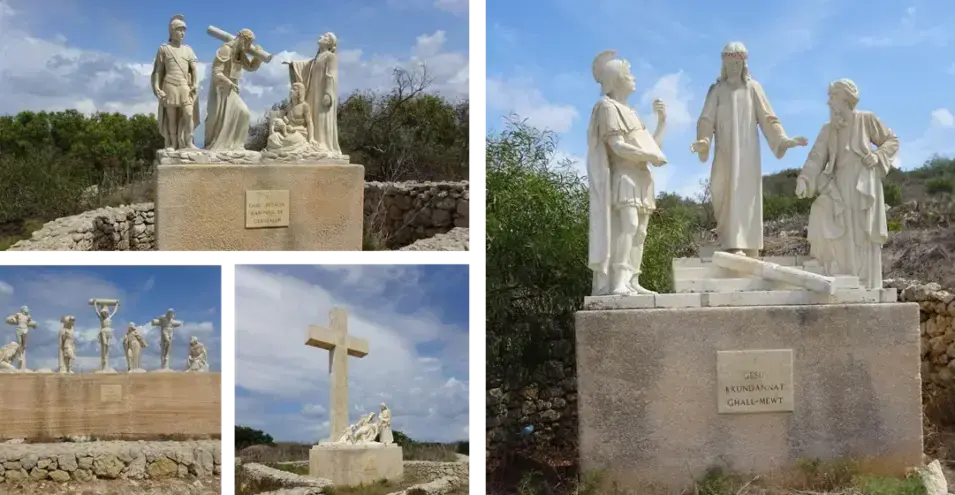
Not exactly. The route contains fourteen stations or representations, but the first is a bas-relief on the church parvis. Several of the other stations are sculptural groups containing more than one human figure.
Do the sculptures follow the traditional Stations of the Cross?
No. The Ta' Għammar sequence follows the Biblical account of the Passion more closely than the traditional devotional sequence commonly displayed inside Catholic churches.
What does Via Crucis mean?
Via Crucis is Latin for Way of the Cross. It refers to a devotional route that recalls the suffering and final journey of Jesus Christ.
Does the route end with the Crucifixion?
No. One of the special characteristics of this route is that it continues beyond the Crucifixion and burial to conclude with the Resurrection.
What is shown at the final station?
The final representation celebrates the Resurrection of Christ. It is located near the upper part of the route and the open-air gathering area.
Who designed the sculptures?
The original artistic models were created by the Maltese sculptor Alfred Camilleri Cauchi, who is well known for his religious sculptures in Malta and Gozo.
Where were the sculptures produced?
The sculptural works were produced in Pietrasanta, Italy, an internationally renowned centre for marble carving and sculpture.
What material was used for the sculptures?
The prominent white sculptural groups were made from marble. Their light colour creates a strong contrast with the natural limestone landscape and Mediterranean sky.
When was the modern Via Crucis created?
Planning and artistic work began during the 1970s, and the sculptures were installed along the hillside during the early 1980s.
Was the hill used for prayer before the statues were installed?
Yes. Local devotees climbed the hill for prayer and acts of penance long before the modern sculptural stations were erected.
Who was Franġisk Portelli?
Franġisk Portelli was closely connected with the Ta' Pinu story and encouraged devotion to the hidden wound on Christ's shoulder. This devotion helped inspire penitential walks up Ta' Għammar Hill.
What is the hidden shoulder wound of Christ?
It is a Catholic devotion concerning the wound believed to have been caused by the heavy wooden cross resting on Christ's shoulder. It is devotional tradition rather than a wound described in detail in the Gospels.
Who was Frenc tal-Għarb?
Frenc tal-Għarb was a respected Gozitan religious figure who spent time praying and meditating on Ta' Għammar Hill. He encouraged group prayer there and supported the idea of creating a Via Crucis on the hill.
Is the walk only intended for Catholic pilgrims?
No. The route is open to respectful visitors of all religions and beliefs. Many people walk it because of the landscape, sculptures, history and panoramic views.
Is admission to the walk free?
Yes. There is normally no admission charge to walk the outdoor route.
Do I need to reserve a time?
No reservation is normally needed for an individual visit. Organised religious or tour groups may wish to contact Ta' Pinu in advance.
Does the walk have fixed opening hours?
It is an outdoor route and does not operate like a ticketed indoor attraction. Nevertheless, daylight visits are strongly recommended, and access may be affected by ceremonies, maintenance or exceptional conditions.
Can I complete the walk when the basilica is closed?
The outdoor hillside may remain accessible independently of the basilica's visiting hours. However, you may not be able to enter Ta' Pinu or use its visitor facilities when the church complex is closed.
How long does the complete walk take?
Walking continuously takes considerably less time than a reflective visit. Most visitors should allow approximately 45 to 90 minutes for the climb, stops at the sculptures, time at the summit and the return journey.
How long does the uphill section take?
Walking time depends on fitness, weather and the number of stops. Many visitors take roughly 20 to 30 minutes to reach the upper area, but a slower pace is recommended in hot weather.
Is the Ta' Għammar walk difficult?
The route is relatively short but includes a noticeable and sometimes steep ascent. It is best described as an easy-to-moderate walk for visitors with normal mobility.
Is specialist hiking experience required?
No technical hiking or climbing experience is normally required. Suitable footwear, care on uneven surfaces and a reasonable level of mobility are more important.
Is the path completely paved?
Visitors should not expect a perfectly smooth urban pavement. Parts of the route may be rough, uneven or affected by loose material and natural limestone.
Are there steps on the route?
The terrain and path design vary along the climb. Visitors who find steps or uneven changes of level difficult should inspect the lower section before committing to the full route.
Are there handrails?
Handrails should not be expected throughout the route. Anyone who depends on continuous support should carefully assess whether the walk is suitable.
Are there places to rest?
Visitors can pause at the stations and in wider areas along the route. Formal seating is not guaranteed at every section, so walkers should be prepared to stand while resting.
Is the walk wheelchair accessible?
The full hillside route is not considered wheelchair accessible because of its gradients and uneven surfaces. The Ta' Pinu church parvis and lower surroundings are considerably easier to access.
Is the route suitable for mobility scooters?
Generally no. The gradient, surface and turning space can make the route unsuitable or unsafe for mobility scooters.
Can visitors use a walking stick?
A walking stick may provide useful support, particularly on the descent. It should have a suitable tip that grips well on stone surfaces.
Is the walk suitable for elderly visitors?
Fit older visitors may complete it comfortably at a slow pace. Anyone with heart, breathing, balance or mobility problems should be cautious and may prefer to explore only the lower section.
Is the walk suitable for children?
School-age children accustomed to walking can normally complete the route. Parents should supervise them closely near the road, on steep sections and around the sculptures.
Can I take a pushchair?
A pushchair is not recommended for the full route because of the incline and uneven ground. A child carrier may be more practical, provided the adult can safely manage the additional weight.
Are dogs allowed on Ta' Għammar Hill?
The outdoor setting may be accessible with a dog, but animals should remain under close control and must not disturb pilgrims, wildlife or religious gatherings. Owners should remove all waste.
Should dogs attempt the walk during summer?
Avoid walking dogs during the hottest part of the day. Stone surfaces can become very hot and there is limited shade. Carry water and check the ground temperature before starting.
What footwear should I wear?
Wear trainers or walking shoes with a good grip. Smooth-soled sandals, flip-flops and high heels are unsuitable for the incline and uneven surfaces.
Is there much shade?
Shade is limited on much of the open hillside. A hat, sunscreen and sufficient drinking water are important during sunny weather.
Is drinking water available on the hill?
Do not rely on finding drinking water along the hillside route. Bring enough water before starting, especially during spring, summer and early autumn.
Are food and drinks sold along the route?
The Via Crucis is not a commercial walking attraction and visitors should not expect cafés or refreshment stalls on the hill. Obtain supplies before beginning the climb.
Can I eat during the walk?
A small snack can be carried, but visitors should respect the religious character of the site, avoid eating beside people who are praying and take all rubbish away.
Are toilets available on the hill?
Visitors should not expect toilet facilities along the hillside route. Facilities associated with Ta' Pinu may be available during the sanctuary's normal opening hours.
What is the best time of day for the walk?
Early morning and late afternoon usually provide more comfortable temperatures and softer light. Avoid the hottest hours during summer.
What is the best season to visit?
Spring is particularly attractive because the countryside is greener and wildflowers may be present. Autumn and winter usually offer cooler walking conditions, while summer requires careful heat planning.
Is it safe to walk at midday in summer?
It is better to avoid the midday heat. The exposed hillside can become extremely hot, and the combination of direct sun and physical exertion increases the risk of dehydration and heat exhaustion.
Can I walk the route after rainfall?
Extra care is required after rain because limestone and smooth surfaces can become slippery. Postpone the climb when the route appears unsafe or when heavy rain is continuing.
Is the route safe during strong winds?
The exposed upper hillside can be uncomfortable in strong winds. Avoid the walk during severe weather warnings or when maintaining balance becomes difficult.
Can I walk at sunset?
Yes, sunset can provide beautiful light, but begin early enough to descend safely before darkness. Carrying a charged phone and a torch is sensible.
Is the route illuminated at night?
Visitors should not assume that every part of the path is continuously or sufficiently illuminated. A daylight visit is safer and makes the sculptures and views easier to appreciate.
Can I visit the route alone?
Many people walk it alone during daylight. Tell someone where you are going, carry a charged phone and avoid isolated hillside walking in poor weather or darkness.
Is mobile telephone reception available?
Mobile reception is generally available in populated parts of Gozo, but it should never be treated as guaranteed. Download any maps or information needed before beginning.
Are the sculptures easy to find?
The sculptures are positioned along the established uphill route. Begin with the Last Supper at Ta' Pinu and then follow the path on the opposite hill in the correct order.
Are information panels provided at every station?
The amount and condition of on-site interpretation may change. Visitors interested in the religious meaning can consult the official Ta' Pinu Via Crucis meditations before or during the walk.
Can the official meditations be read online?
Yes. Ta' Pinu publishes meditations and Biblical readings for the individual Via Crucis stations through its official resources.
Is there an open-air amphitheatre at the top?
Yes. An outdoor gathering and worship area was developed near the summit for religious celebrations, prayer and organised pilgrimages.
Can visitors enter the amphitheatre?
It can normally be approached as part of the walk, provided no restricted ceremony, maintenance work or safety closure is in progress.
Are religious ceremonies still held on the hill?
Yes. Ta' Għammar remains a living pilgrimage site, and communal prayer or penitential events may take place, especially during Lent and Holy Week.
Is the route busier during Lent and Holy Week?
Yes. The religious significance of the Via Crucis attracts more pilgrims during these periods. Visitors should respect organised services and allow participants space for prayer.
Can tourists join a public religious procession?
Respectful participation may be possible when an event is open to the public. Follow the organisers' instructions and remember that it is a religious observance rather than a sightseeing performance.
Is photography allowed?
Personal outdoor photography is generally possible. Avoid disrupting prayer, blocking the route or photographing identifiable people during private religious moments without permission.
May I photograph the religious ceremonies?
Photography should be discreet. Do not use flash, move through worshippers or photograph people closely without consent. Organisers may impose additional restrictions.
Can I use a tripod?
A small tripod may be practical when the route is quiet, but it must not block paths, interfere with ceremonies or create a tripping hazard.
Can I fly a drone over Ta' Għammar Hill?
Drone use is subject to current Maltese and European aviation rules, geographical restrictions, privacy requirements and any permission needed from the relevant land or site authority. The open countryside does not automatically make a flight legal.
What views can be seen from the route?
The climb offers broad views across the rural landscape of western Gozo. Depending on position and visibility, visitors can see Ta' Pinu Basilica, surrounding villages, agricultural land and the Ta' Ġurdan lighthouse area.
Can Ta' Pinu Basilica be photographed from the hill?
Yes. Elevated sections provide attractive views back towards the basilica, particularly when the light illuminates its golden limestone façade.
Is the walk worthwhile for non-religious visitors?
Yes. The sculptures, landscape, views, outdoor art and local history make it worthwhile even for visitors who do not approach it as a pilgrimage.
Can I combine the walk with Ta' Pinu Basilica?
Yes. The two attractions are directly connected and are best visited together. Allow sufficient time for the basilica, museums if open, the hill climb and the return journey.
Should I visit the basilica or the hill first?
Beginning at Ta' Pinu is the most logical sequence because the first Via Crucis representation is situated on the church parvis. You can then cross to the hill and continue the route.
How much time should I allow for Ta' Pinu and the walk together?
Allow at least two hours for a comfortable combined visit. More time is needed when attending Mass, visiting museums, taking extensive photographs or following the devotional meditations.
Is parking available near the start?
Parking is available in the Ta' Pinu area. Availability may be more limited during major religious events, feast days and busy visitor periods.
Is parking normally free?
Parking around Ta' Pinu is normally available without an attraction admission fee, but drivers must always follow current signs, restrictions and designated parking arrangements.
Can I reach Ta' Għammar Hill by bus?
Yes. Public bus route 308 serves the Ta' Pinu and surrounding area from Victoria. Routes and timetables can change, so check the Malta Public Transport journey planner before travelling.
Can I travel directly from Mġarr Harbour by bus?
A connection through Victoria is commonly required. Confirm the best current journey shortly before departure, particularly on Sundays and public holidays.
Can a taxi drop me at the beginning of the walk?
Yes. Ask the driver for Ta' Pinu Basilica. The church parvis and the hill entrance are then close together.
Do hop-on hop-off buses stop near Ta' Pinu?
Some Gozo sightseeing routes include Ta' Pinu, but routes, seasons and stop durations vary. Check the current operator timetable before purchasing a ticket.
Do normal Gozo tours include the hill walk?
Not usually. Many tours stop at Ta' Pinu Basilica but allow too little time to climb Ta' Għammar Hill. Read the itinerary carefully before booking.
What type of tour is best for completing the walk?
A private or flexible small-group tour is usually the best option because the stop at Ta' Pinu can be extended. Confirm the required time with the operator before booking.
Can the route be included in a private Gozo tour?
Yes. Ask the guide to include enough time for both Ta' Pinu Basilica and the complete Ta' Għammar Hill walk rather than only an exterior photo stop.
Can I combine the walk with Dwejra?
Yes. Dwejra lies in western Gozo and can easily be combined with Ta' Pinu and Ta' Għammar Hill by car, taxi or organised tour.
Can I combine the walk with the Citadel?
Yes. The Citadel in Victoria is a convenient addition to the same day, particularly when travelling through the Victoria bus terminal.
Are there restaurants near the route?
Restaurants and cafés can be found in Għarb, San Lawrenz and Victoria. The hill itself should not be treated as a place where meals or refreshments can be purchased.
Can I leave rubbish on the route?
No. Take all bottles, food packaging and other waste away with you. The hillside is both a religious site and a natural landscape.
May visitors touch or climb on the sculptures?
No. Do not climb, sit or lean on the sculptures. Marble can be damaged and climbing may also cause injury.
Are bicycles suitable for the route?
The Via Crucis is intended primarily for pedestrians and pilgrims. Cycling could endanger walkers, damage the path or disturb the religious character of the site.
Can I run up Ta' Għammar Hill?
Running is not advisable when other visitors or pilgrims are present. The incline, uneven ground and religious use of the route require a controlled and respectful pace.
What should I take with me?
Take drinking water, sun protection, suitable footwear, a charged mobile phone and any personal medication. A light jacket may be useful during cooler or windy weather.
What should I do in an emergency?
Call the European emergency number 112 if urgent medical, police or rescue assistance is required. Clearly state that you are on Ta' Għammar Hill opposite Ta' Pinu Basilica in Gozo.