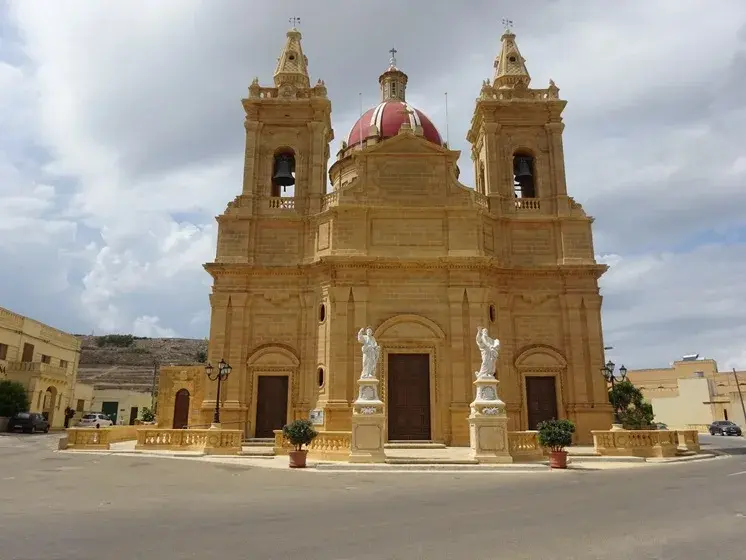
Church of Christ the Saviour in Għasri, Gozo – Complete Visitor Guide
The Church of Christ the Saviour stands at the centre of Għasri, one of Gozo’s smallest and most peaceful villages. The parish is dedicated to the Real Presence of Jesus Christ in the Eucharist and the church is therefore also known as Corpus Christi Church or the Church of Christ the Eucharistic Saviour.
The building is immediately recognisable by its symmetrical limestone façade, twin bell towers and red dome. Although it is younger than many historic churches in Gozo, it is closely connected with the identity, traditions and daily life of Għasri.
Inside, the principal artistic work is The Last Supper by the respected Maltese artist Lazzaro Pisani. The painting expresses the Eucharistic dedication of the parish and occupies an important position in the choir.
The church is also an excellent starting point for exploring rural western Gozo. Nearby attractions include Wied il-Għasri, Ta’ Ġurdan Lighthouse, the Basilica of the Patronage of Our Lady, Għarb, Ta’ Pinu and Dwejra Bay.
This visitor guide explains the church’s history, architecture, art, Mass times, accessibility and practical information for visitors.
What Is the Correct Name of the Church?
The church is known by several closely related names.
Common English names include:
Church of Christ the Saviour
Parish Church of Christ the Saviour
Għasri Parish Church
Corpus Christi Church
Church of Christ the Eucharistic Saviour
Maltese references may include:
Knisja Parrokkjali Kristu Salvatur
Parroċċa Kristu Ewkaristiku Salvatur
Knisja Parrokkjali tal-Għasri
These names refer to the same Roman Catholic parish church in the village square of Għasri. Adding “Għasri, Gozo” helps distinguish it from other churches dedicated to Christ the Saviour.
Where Is the Church of Christ the Saviour?
The church stands on Pjazza Salvatur in the centre of Għasri, on the western side of Gozo.
Address:
2, Pjazza Salvatur
Għasri
Gozo
Malta
GSR 1101
Għasri lies between Victoria, Żebbuġ, Għarb, San Lawrenz and Kerċem. Although the village has a small population, its territory extends across a broad rural landscape of valleys, fields and hills.
The church dominates the village square. Visitors approaching by car or bus will see its twin towers and red dome rising above the surrounding limestone houses.
Why Visit Għasri Parish Church?
The Church of Christ the Saviour is worth visiting for its architecture, art, history and continuing religious importance.
The church was designed by a local priest, Dun Ġużepp Diacono. Its foundation stone was laid in 1903, the completed church was consecrated in 1916 and Għasri became an independent parish in 1921.
The church contains The Last Supper by Lazzaro Pisani. Its façade and parvis also underwent a major restoration project inaugurated in 2019.
The peaceful location offers a quieter experience than Gozo’s busiest churches. A visit can be combined easily with Wied il-Għasri, Ta’ Ġurdan Lighthouse, Ta’ Pinu Basilica, Għarb and Dwejra Bay.
Religious History Before the Present Parish Church
Christian worship in the Għasri area predates the present parish church by centuries.
Before Għasri became an independent parish, residents depended on churches and chapels connected with neighbouring communities. Several small places of worship served the dispersed rural settlements surrounding the village.
One of the most important was the Basilica of the Patronage of the Blessed Virgin Mary in Wied il-Għasri. The first chapel on that site dates back to the sixteenth century. The present church was developed during the eighteenth century and became an important centre of Marian devotion.
The basilica was associated with the papal Basilica of St Mary Major in Rome and became Gozo’s oldest minor basilica. It served as the principal religious centre for the locality before the present parish church was established.
As the village community developed, the need arose for a larger church in a more central location.
Construction of the Present Church
The present church was designed by the Gozitan priest Dun Ġużepp Diacono.
Its foundation stone was laid on 6 September 1903. Construction took place during a period when transport, lifting equipment and building technology were far more limited than today. The work depended heavily on local craftsmen, traditional masonry, manual labour and the support of parishioners.
The use of local limestone connected the new church visually with Gozo’s older religious architecture. Its twin towers, central façade and dome created a recognisable Maltese ecclesiastical silhouette.
The church was completed and consecrated on 9 January 1916 by Bishop Giovanni Maria Camilleri. It was dedicated to Corpus Christi, the Body and Blood of Christ, reflecting the Eucharistic identity that remains central to the parish.
Establishment of Għasri Parish
The completion of the church did not immediately make Għasri a separate parish.
Pope Benedict XV authorised the formation of the Corpus Christi Parish by decree on 19 May 1921. Għasri was formally established as an independent parish on 16 December 1921 by Bishop Giovanni Maria Camilleri.
The new parish territory was formed from areas that had previously belonged to Victoria, Żebbuġ and Għarb. Żebbuġ was recognised as the mother parish.
Dun Ġużepp Galea became the first parish priest.
The parish church then became the setting for baptisms, marriages, funerals, First Holy Communion, Confirmation, feast celebrations and the ordinary rhythm of Catholic worship.
In 2021, the parish celebrated the centenary of its establishment.
Christ the Eucharistic Saviour
The parish is dedicated to the Real Presence of Jesus Christ in the Eucharist.
This explains why the building may be described as both Corpus Christi Church and the Church of Christ the Saviour. The title focuses on Christ present in the Eucharist and on salvation through Christ.
Corpus Christi means “the Body of Christ”. In Catholic teaching, the term is especially associated with belief in the presence of Christ in the consecrated bread and wine during Mass.
The parish emblem created for the centenary reflects this identity. Its imagery includes the sun as a symbol of the Risen Christ and the Eucharist, together with references to Christ’s sacrifice, Gozo and the earlier Marian tradition of the locality.
The Titular Painting – The Last Supper by Lazzaro Pisani
The most important painting in the church is The Last Supper by Maltese artist Lazzaro Pisani, who lived from 1854 to 1932.
The large work occupies a prominent position in the choir. It depicts the institution of the Holy Eucharist during the Last Supper, showing Jesus Christ and the twelve Apostles.
The painting was commissioned by the curator and vice-parish priest, the Reverend Carmelo Caruana. It was installed on 3 June 1917, shortly after the church had been consecrated.
The subject is especially appropriate for a church dedicated to Corpus Christi. It is not simply decorative; it visually expresses the theological identity of the parish.
After approximately ninety years, the heavy canvas had developed creases and was separating from its wooden frame. Damp behind the painting had also caused patches on the reverse side.
The painting was restored by Emanuel Zammit of Żejtun, who had previously undertaken restoration work at the Gozo Cathedral. Bank of Valletta sponsored the project.
The decorative frame was created by Antonio Agius and completed after the painting was installed. His work in the church is considered an important part of his artistic achievement.
Visitors should view the painting quietly and avoid flash photography unless permission has been granted.
Other Sacred Art Inside the Church
The artistic importance of the church extends beyond the titular painting.
Religious statues, altar furnishings, devotional images, decorative stonework and liturgical objects contribute to the character of the interior. Their significance is connected both with artistic craftsmanship and with the religious life of the parish.
The arrangement may change during Lent, Easter, Corpus Christi, Advent, Christmas and the parish feast.
The church is an active place of worship rather than a museum. Some areas or objects may not be accessible. When the building is open outside a service, visitors should observe the relationship between the choir, altar, dome and side areas without entering restricted spaces.
Architecture of the Church
The Church of Christ the Saviour presents a monumental façade despite the modest size of the surrounding village.
Its design follows a balanced three-part composition. The principal entrance occupies the central section, while two bell towers rise on either side. The red dome is visible behind the façade.
The church is built mainly from the warm honey-coloured limestone characteristic of Malta and Gozo. In bright sunlight, the stone appears golden. During late afternoon or under cloud, shadows reveal the carved details and projecting architectural elements more clearly.
The Main Façade
The façade is arranged symmetrically around the central doorway.
The main entrance is framed by carved limestone and topped by a rounded architectural feature. Smaller entrances occupy the side sections beneath the bell towers.
Vertical elements divide the façade and emphasise its height. Horizontal cornices create visual stages between the entrances, upper façade and towers.
Step back across the square to appreciate the complete composition. From close range, the carved door surrounds and stonework can be examined in greater detail.
The Twin Bell Towers
Two bell towers frame the church façade.
Each tower contains an open bell chamber and is crowned by a narrower upper stage. Their position creates the balanced silhouette associated with many Maltese parish churches.
Church bells traditionally announced Masses, feasts, funerals and other important community events. Visitors should expect bell ringing around services and celebrations.
The Red Dome
The red dome is one of the church’s most distinctive external features.
It rises behind the façade and is topped by a lantern and cross. Its colour provides a strong contrast with the pale limestone walls.
From viewpoints in the surrounding countryside, the dome and twin towers form a useful visual marker for the centre of Għasri.
The Parvis and Village Square
The formal space immediately in front of the church is known as the parvis.
It creates a transition between the public village square and the sacred interior. Stone balustrades, steps, statues and lamps provide a ceremonial setting for the façade.
The parvis becomes especially important during processions and feast celebrations. Visitors should avoid blocking entrances, steps and processional routes.
The Statues Outside the Church
Two white statues stand prominently in front of the façade.
Their light colour contrasts with the warm limestone and makes them clearly visible from across the square. They strengthen the ceremonial character of the parvis and direct attention towards the main entrance.
Include the statues when photographing the complete façade because they form part of the designed approach to the church.
Restoration of the Exterior and Parvis
The church’s exterior and parvis underwent an important restoration supported through European Union funding.
A plaque records that the project formed part of an initiative to enhance Gozo’s ecclesiastical and artistic cultural heritage for present and future generations.
The restored exterior and parvis were inaugurated on 1 November 2019.
The plaque records the participation of Bishop of Gozo Mario Grech and Parliamentary Secretary Aaron Farrugia, in the presence of Minister for Gozo Justyne Caruana.
The project was co-financed by the European Union through the European Regional Development Fund and national funds.
Restoration of exposed limestone can involve cleaning, repairing damaged stone, conserving carved details, replacing unsuitable materials and improving joints and paving. Such work protects the church from the long-term effects of rain, wind, airborne salts, biological growth and earlier repairs.
The Church as the Centre of Village Life
Għasri is known for its tranquillity, rural surroundings and small population.
In this setting, the parish church is more than an architectural landmark. It is a focus for worship, community identity, social connection and local memory.
The parish organises Masses, Eucharistic devotion, confessions, catechism and pastoral activities. Baptisms, weddings, funerals and other important moments connect generations of Għasri families with the building.
For visitors, this active role is one of the most valuable aspects of the experience. The church is not an isolated historic monument; it remains part of daily village life.
The Parish Feast
The parish dedication is associated with Corpus Christi and Christ the Eucharistic Saviour.
The feast normally includes special Masses, prayers, decorations, music, bells and a procession with the titular statue of Christ the Saviour. The programme can also include community events and fireworks.
Dates and arrangements can change each year. Visitors planning a feast visit should consult the official parish website, weekly bulletin or current notices.
During the feast period, the church may be richly decorated, but access and parking around the square may be more restricted.
Visitors are welcome to observe public celebrations respectfully. Religious services and processions should not be treated only as tourist entertainment.
Current Mass Times
The official parish website currently lists the following regular Mass times.
Monday to Saturday
7:30 a.m.
6:30 p.m.
During Marian Wednesdays from May to August, the evening Mass is celebrated at the Basilica of the Patronage of Our Lady in Wied il-Għasri instead of the parish church.
Sundays and Feasts
8:30 a.m.
10:30 a.m.
The Sunday evening Mass is celebrated at the Basilica of the Patronage of Our Lady rather than at the parish church.
Basilica of the Patronage of Our Lady
Sunday evening:
6:00 p.m.
Marian Wednesdays from May to August:
6:30 p.m.
Mass times can change for religious feasts, funerals, weddings, Holy Week, Christmas, summer arrangements and special parish events.
Always verify the latest schedule on the official parish website shortly before travelling.
Automatic Mass-Times Display
The parish publishes its Mass timetable on a dedicated official webpage.
The safest solution for MaltaGuide is to display the normal timetable on the page and place a clear button or text link underneath it directing visitors to the official live schedule.
Automatically extracting the timetable from the visual layout of another website is less reliable. It may stop working if the parish changes the design or technical structure of its page.
A direct official link therefore provides the best combination of useful information and accuracy.
Eucharistic Adoration
The parish also publishes regular Eucharistic Adoration times.
Adoration is normally held on Thursdays, except the Thursday immediately before the first Friday of the month.
Winter:
8:00 a.m. to 6:00 p.m.
Summer:
8:00 a.m. to 12:00 noon
4:00 p.m. to 6:00 p.m.
On the first Friday of the month, the same winter and summer hours apply.
On the first Saturday of the month, guided adoration begins at 6:45 p.m. and includes Lectio Divina, a healing service and sacramental benediction.
These arrangements can change, so consult the official parish website before making a special journey.
Opening Hours
The church does not operate as a museum with guaranteed continuous tourist opening hours.
It is most likely to be open around scheduled Masses, services, Eucharistic Adoration, parish activities and special celebrations. The doors may be closed at other times.
Visitors who want to see the interior should arrive before a scheduled Mass while allowing enough time not to disturb preparations.
For an organised group or a visit requiring certainty, contact the parish in advance.
Parish telephone: +356 7908 2170
Parish email: info@ghasriparish.org
Parish Office Hours
The official parish website lists the following office hours:
Tuesday:
9:00 a.m. to 10:30 a.m.
Thursday:
9:00 a.m. to 10:30 a.m.
Sunday:
9:15 a.m. to 10:30 a.m.
A member of the parish council is normally available during these times for administrative and logistical matters without an appointment.
Admission Price and Donations
There is normally no admission charge to enter an active Catholic parish church for prayer or a respectful visit.
A voluntary donation may be welcomed for maintenance, restoration and parish activities.
Do not confuse a voluntary contribution with an entrance fee.
Dress Code and Respectful Behaviour
Wear clothing appropriate for an active Catholic church.
Shoulders and the upper body should be reasonably covered.
Very short shorts and revealing beachwear should be avoided.
Remove hats when entering, except where worn for religious or medical reasons.
Speak quietly and place mobile phones on silent.
Do not walk around during the most solemn parts of Mass.
Do not enter the sanctuary or pass behind barriers.
Do not touch paintings, statues, vestments or liturgical objects.
Children should remain supervised.
Visitors are not required to be Catholic, but everyone should respect the purpose of the building.
Photography Inside the Church
Photography may be possible outside services, but permission should not be assumed.
Avoid flash because it can disturb worshippers and may be unsuitable near historic artworks.
Do not photograph people praying without their permission.
Photography, filming and tripod use should stop during Masses, funerals, weddings and private devotional moments unless explicit permission has been obtained.
Commercial photography requires advance approval.
The exterior can generally be photographed from the public square, provided entrances, worshippers and traffic are not obstructed.
Accessibility
The church stands directly beside the village square, making the exterior relatively easy to approach.
The parvis and entrances include changes in level, steps and traditional stone surfaces. Exact access conditions should be checked on arrival because not every doorway may be open.
Visitors using wheelchairs or mobility aids should contact the parish in advance when guaranteed step-free entry is required.
The square is comparatively level, but kerbs, pavements and parked vehicles can create difficulties.
Visiting with Childre
Families may visit the church, provided children are supervised.
Explain before entering that the building is a place of worship.
Keep voices low and do not allow children to climb on statues, balustrades, steps or church furnishings.
During Mass, choose a seat from which the family can leave quietly when necessary.
Best Time to Visit
Early morning is usually best for peaceful surroundings, cooler temperatures and easier exterior photography.
Late afternoon can provide warm light on the limestone façade.
A visit shortly before a regular Mass may provide the best opportunity to find the church open, but sightseeing should stop as worshippers arrive.
Sunday morning allows visitors to experience the building as an active parish, although the service must be respected.
The feast period can be visually impressive but busier.
Spring and autumn are ideal for combining the church with countryside walks. Summer afternoons can be very hot.
How Long Should You Allow?
Allow approximately 15 to 20 minutes for the exterior and village square.
Allow 30 to 45 minutes when the church is open and you want to view the interior carefully.
Allow one to two hours when combining the parish church with the nearby Basilica of the Patronage.
Allow half a day when continuing towards Wied il-Għasri or Ta’ Ġurdan Lighthouse.
How to Get There
By Car
Għasri is a short drive from Victoria.
Follow the road towards Għarb and the signs for Għasri. Village roads can be narrow, so drive slowly and remain alert to pedestrians, parked vehicles and agricultural traffic.
By Public Bus
The official parish website identifies bus route 308 as the service from Victoria, passing Ta’ Pinu and Għasri village square before returning to Victoria.
Bus routes and schedules can change. Always check the current Malta Public Transport journey planner before travelling.
By Taxi or Ride-Hailing Service
A taxi is convenient when combining Għasri with Wied il-Għasri, Ta’ Pinu or Dwejra.
Arrange collection in advance when travelling late in the day or outside busy tourism periods.
By Bicycle
The surrounding rural roads are attractive for cycling, especially during spring and autumn.
Gozo is hilly and village roads can be narrow. Wear a helmet, carry drinking water and remain alert to traffic.
On Foot
Experienced walkers can reach Għasri through countryside routes from neighbouring villages.
Use a reliable map, avoid private land and carry sufficient water. Summer walking is best undertaken early in the morning or late in the afternoon.
Parking
Limited parking may be available around the village square and nearby streets.
Do not park directly in front of church entrances, on the parvis, beside access ramps or where signs prohibit parking.
Spaces may be more difficult to find during Masses, funerals, weddings and feast events.
Early morning often provides the best opportunity for an unobstructed photograph of the façade.
Facilities Near the Church
Għasri is a small village rather than a major tourist centre.
Facilities are more limited than in Victoria, Xlendi or Marsalforn.
Carry drinking water, particularly when continuing on foot into the countryside.
Public toilet availability should not be assumed.
Opening hours of small businesses may vary.
For a larger selection of cafés, restaurants, shops and services, continue to Victoria or another larger locality.
Basilica of the Patronage of Our Lady
The Basilica of the Patronage of Our Lady is an important historic church within Għasri Parish.
It stands in the Wied il-Għasri area and predates the present parish church.
The site’s religious history reaches back to a sixteenth-century chapel. The present church developed during the eighteenth century and was associated with the papal Basilica of St Mary Major in Rome.
It became Gozo’s first minor basilica and served as the local spiritual centre before the present parish was established.
The basilica contains important works of religious art, including a titular painting attributed to Francesco Zahra.
Regular Sunday evening Mass and Marian Wednesday celebrations take place there according to the parish schedule.
Visitors interested in the history of Għasri Parish should see both churches because together they explain the development of Catholic worship in the locality.
Nearby Attractions
Wied il-Għasri
Wied il-Għasri is one of Gozo’s most distinctive valleys.
A narrow inlet lies between high cliffs where the valley reaches the sea. The area is popular for walking, photography, swimming and snorkelling when conditions are safe.
Ta’ Ġurdan Lighthouse
Ta’ Ġurdan Lighthouse stands on a prominent hill above Għasri.
The lighthouse was inaugurated in 1853 and is one of the best-known landmarks in western Gozo. The hill provides extensive views, although access to the lighthouse interior is not guaranteed.
Ta’ Pinu Basilica
Ta’ Pinu is one of Malta’s most important Catholic shrines.
Its monumental architecture, rural location and religious history make it an excellent addition to a church-focused itinerary.
Għarb
Għarb is a traditional village west of Għasri.
Its parish church, village square, old houses and nearby countryside make it worth exploring.
Dwejra Bay
Dwejra is known for the former Azure Window site, Fungus Rock, Dwejra Tower, the Inland Sea and the Blue Hole.
It is a convenient continuation from Għasri by car or organised tour.
Victoria and the Citadel
Victoria is the capital of Gozo.
The historic Citadel contains churches, museums, fortifications and panoramic viewpoints, while the town centre offers shops, restaurants and transport connections.
Xwejni Salt Pans
Traditional salt pans line the coast near Xwejni.
The geometric limestone basins form one of Gozo’s most recognisable coastal landscapes.
Wied il-Mielaħ Natural Arch
Wied il-Mielaħ contains a surviving natural limestone arch on Gozo’s northern coast.
The rural roads and coastal paths require care, particularly during bad weather.
Suggested Half-Day Itinerary
Begin at the Church of Christ the Saviour in Għasri.
View the façade, parvis, twin towers and dome.
Enter quietly when the church is open.
Continue to the Basilica of the Patronage of Our Lady.
Walk or drive towards Wied il-Għasri.
Finish with Ta’ Pinu Basilica or Dwejra Bay.
Visitors using public transport should allow additional time and verify return connections.
Guided Tours of Gozo
Organised Gozo excursions are useful for visitors staying in Malta without a hire car.
Many tours explore western Gozo and may pass through or near Għasri. Not every itinerary includes time inside the parish church.
Tour categories may include:
Gozo jeep tours
Gozo quad bike tours
Gozo buggy tours
Gozo tuk-tuk tours
Gozo UTV tours
Check the detailed itinerary before booking. Do not state that the church is included unless the product description confirms it.
Interesting Facts
The church was designed by the local priest Dun Ġużepp Diacono.
Its foundation stone was laid on 6 September 1903.
The church was consecrated on 9 January 1916.
Għasri became an independent parish on 16 December 1921.
The parish is dedicated to the Real Presence of Christ in the Eucharist.
The titular painting is The Last Supper by Lazzaro Pisani.
The painting was installed on 3 June 1917.
The decorative frame was created by Antonio Agius.
The painting required restoration after its heavy canvas began to crease and separate from its frame.
The exterior and parvis underwent an EU-supported restoration inaugurated in 2019.
The church stands in Gozo’s smallest parish community.
The nearby Basilica of the Patronage represents an earlier chapter in the religious history of Għasri.
The church remains an active parish rather than a museum.
Final Visitor Advice
The Church of Christ the Saviour offers an authentic introduction to the religious and village life of Gozo.
It may not have the international fame of Ta’ Pinu or the Cathedral of the Assumption, but its history, Eucharistic identity, architecture and important Last Supper painting make it a rewarding stop.
Visit quietly, dress respectfully and remember that opening depends primarily on worship and parish activities.
Check the official Mass schedule shortly before travelling when seeing the interior is essential.
Combine the church with the Basilica of the Patronage, Wied il-Għasri, Ta’ Ġurdan Lighthouse, Ta’ Pinu or Dwejra for a fuller experience of western Gozo.